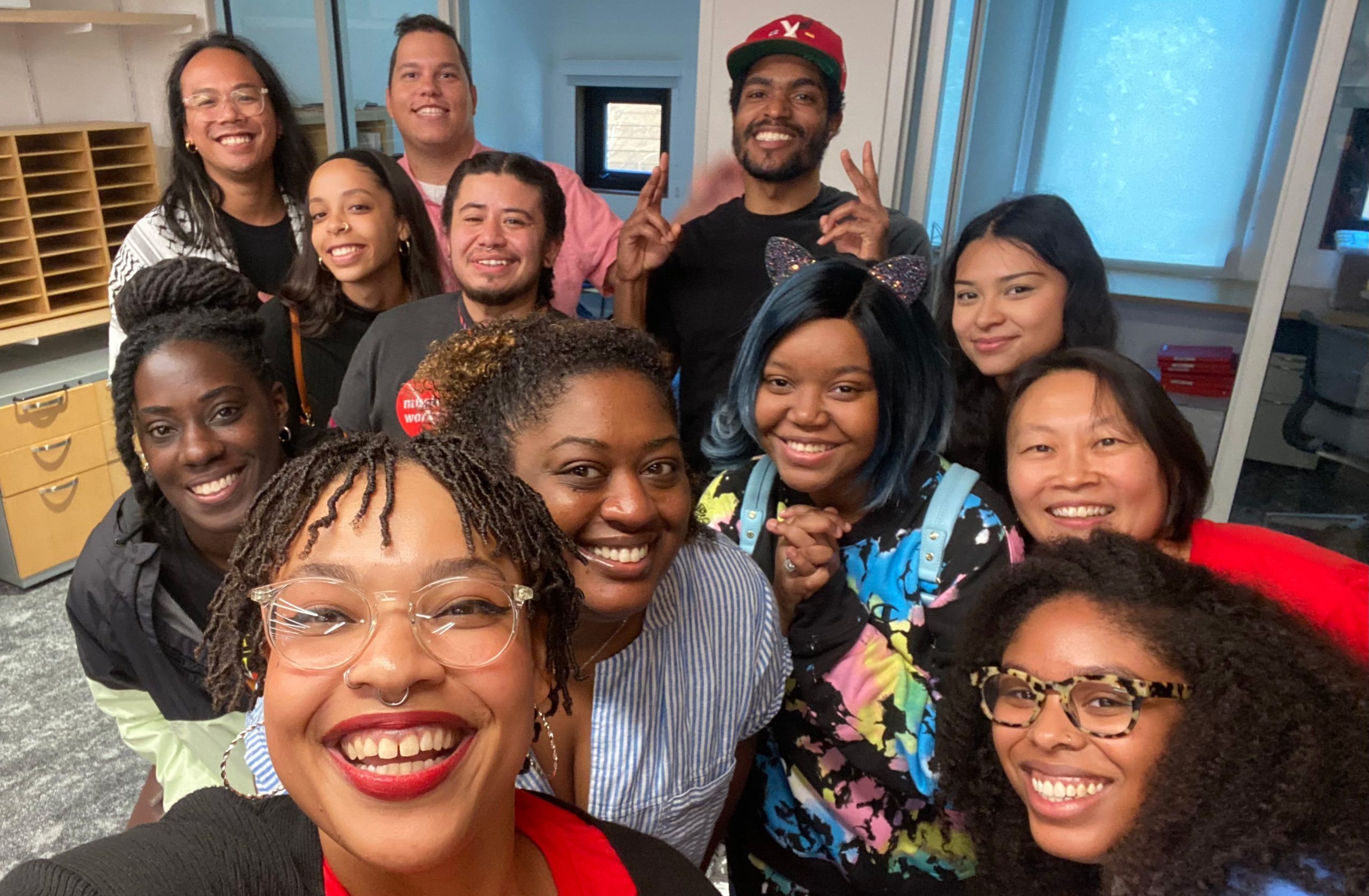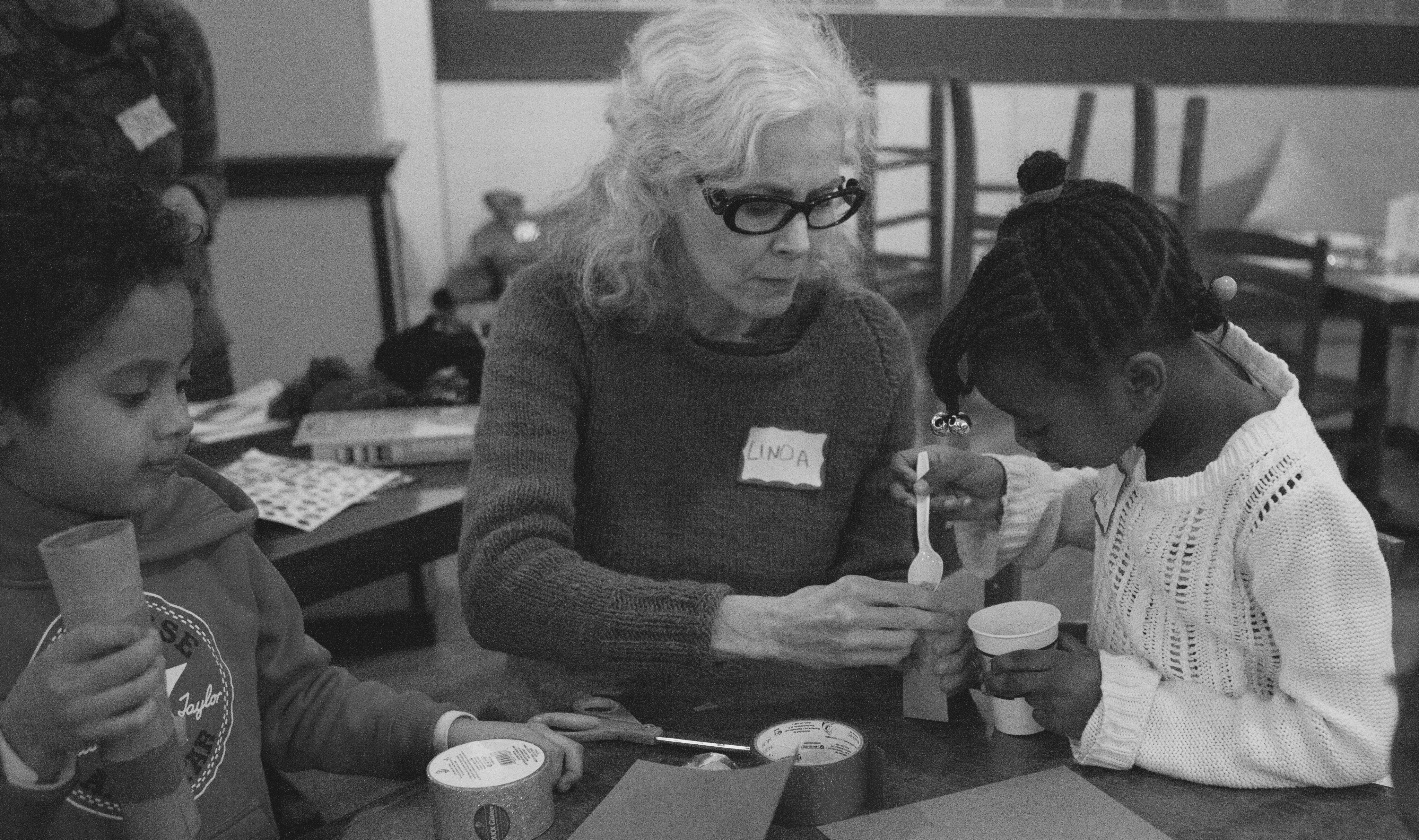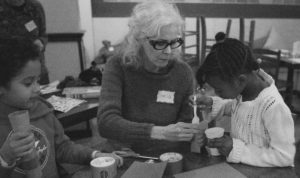
Linda Daniels is a writer, editor, cellist, CMW parent, former CMW Board member and expert eavesdropper. She helms the 20 Years, 20 Stories project and this is her story.
I’ve been an eavesdropper since childhood. My mother liked to pour herself a Royal Crown cola in the late afternoon, park herself on the couch and telephone her mother, which was my cue to c-a-r-e-f-u-l-l-y raise the extension handset upstairs. Usually, they discussed mundane matters: pork chops versus chicken, how this season’s fashions were so unflattering and, now and then, family gossip. The topics were almost beside the point, except for the family gossip, which is why I eavesdropped in the first place. But I was also intrigued by the mysterious current of poetry running beneath even the most routine remarks. I loved the give and take of conversation, the sighs and pauses, the sound of my mother’s sympathetic tsk-tsk’s and my grandmother’s pretty brogue. I almost always got busted and was scolded, but not seriously enough to deter me from future attempts. Talking was as close as my family got to making music. No one sang or played an instrument, and my relatives just embarrassed themselves trying to clap along to music, but man, could these people talk. Listeners, even illicit ones, had a role to play, too. We completed the performance circle.
In college, Studs Terkel’s oral history Working: People Talk About What They Do All Day and How They Feel About What They Do shaped my senior year thesis. I made the leap from habitual eavesdropper to scholarly interviewer and collected the oral histories of women who came of age during the 1920s. The best parts of the resulting 200-plus-page door-stopper were their reminiscences. After college, I became a reporter: more listening, more writing. Even after I quit newspapers and turned to other pursuits, I never lost the eavesdropping habit. My husband recognizes the faraway look that crosses my face when we’re in a public space and I hear something that bears further investigation, convinced, of course, that no one can tell what I’m up to. After 27 years, he also knows that whatever he and I were talking about will have to wait. More recently, I’ve been inspired by writer Svetlana Alexievich, who won a Nobel for Secondhand Time, her beautifully rendered oral history of post-Soviet Russians.
In September, I began an exciting new listening and writing project in connection with Community MusicWorks’ 20th anniversary: collecting 20 representative stories of CMW musicians, staff, students, parents and supporters. I’ve been expertly assisted by CMW fellow Josie Davis, who interviewed three people, and Communications Manager Liz Cox, who proofreads the stories and designs the online content. (Read the stories here.)
It hasn’t been difficult to get people to open up. I’ve been a familiar face at CMW since my youngest had his first cello lesson here ten years ago. I’ve exchanged knowing glances with other parents when a beginner nails “Twinkle” and held a collective breath during the dying notes of a Beethoven quartet performed by the pros. I’ve square-danced to fiddle tunes and attempted, much less successfully, the salsa. I’ve sung rounds and set up folding chairs; fretted over budgets and strategic goals; eased my car past side-view mirrors on snow-bound Messer Street; knitted for newborns; and eaten far too much pizza.
Since people know me better as an at-large mom than as an interviewer and writer, some of my questions may discomfit. Recently, a student I was interviewing put up a hand and blurted, “That’s a weird question!” Um, ok. But can you answer it anyway? I remain confident that what I’m curious about others are too. She answered in good faith, trusting that I have her back. I am honored by that trust. You readers should be also. When people talk honestly they make themselves vulnerable. They don’t want to be misconstrued as they describe emotions and realizations that can’t be summarized by facts alone. This is especially true of CMW’s staff, who are talking about their life’s work.
It’s why I take the final step of the oral history process so seriously: converting 8-20 pages of interview transcript to a narrative that honors the speaker’s intentions, captures history while it’s still occurring, and compels readers. It’s a messy process. No matter how cleverly I order the questions and pursue answers during an interview, the talk meanders, as talk will. Even the most prepared and polished speakers wander off topic and speak colloquially, thank goodness. They are thinking out loud, which is where the music happens. It’s the difference between watching an official read a prepared statement from behind a podium and hearing him speak spontaneously from the heart when a reporter surprises him off-stage by asking exactly the right question at the right moment. I’m going for the latter.
Some “20 Years, 20 Stories” subjects have been flummoxed by the difference between the hour-plus interview they remember and the 2-5 page story I produce, having edited and condensed our conversation to a fare-thee-well, absenting my questions along the way. (Available here, if you’re curious.) They worry about being misperceived and about sounding too casual. They worry that they have said too much or too little. It is scary to see your constantly morphing thoughts marching in regimental black lines across white space. Where are the raised eyebrows signaling sincerity or the smile signaling warmth? Where are the tears that welled up when recalling a triumphant moment with a challenging student? Where’s a second or third chance to rephrase? To be more thoughtful? To explain more fully?
Oral history and chamber music have much in common. Both art forms strive to capture human experience through artifice and collaborative effort, and both are very much of the moment. Therein lies the thrill. Having made the artistic decision to omit interview questions in favor of narrative flow, I don’t worry that readers need cue cards. I trust that readers will appreciate what I appreciate about oral history: the idiosyncratic quirks of everyday speech as thoughtful people talk about things that matter. Subjects can trust their beautiful, one-of-a-kind voices to tell the story. The rest of us can pick up the extension and listen in.
The 20 Years, 20 Stories homepage.
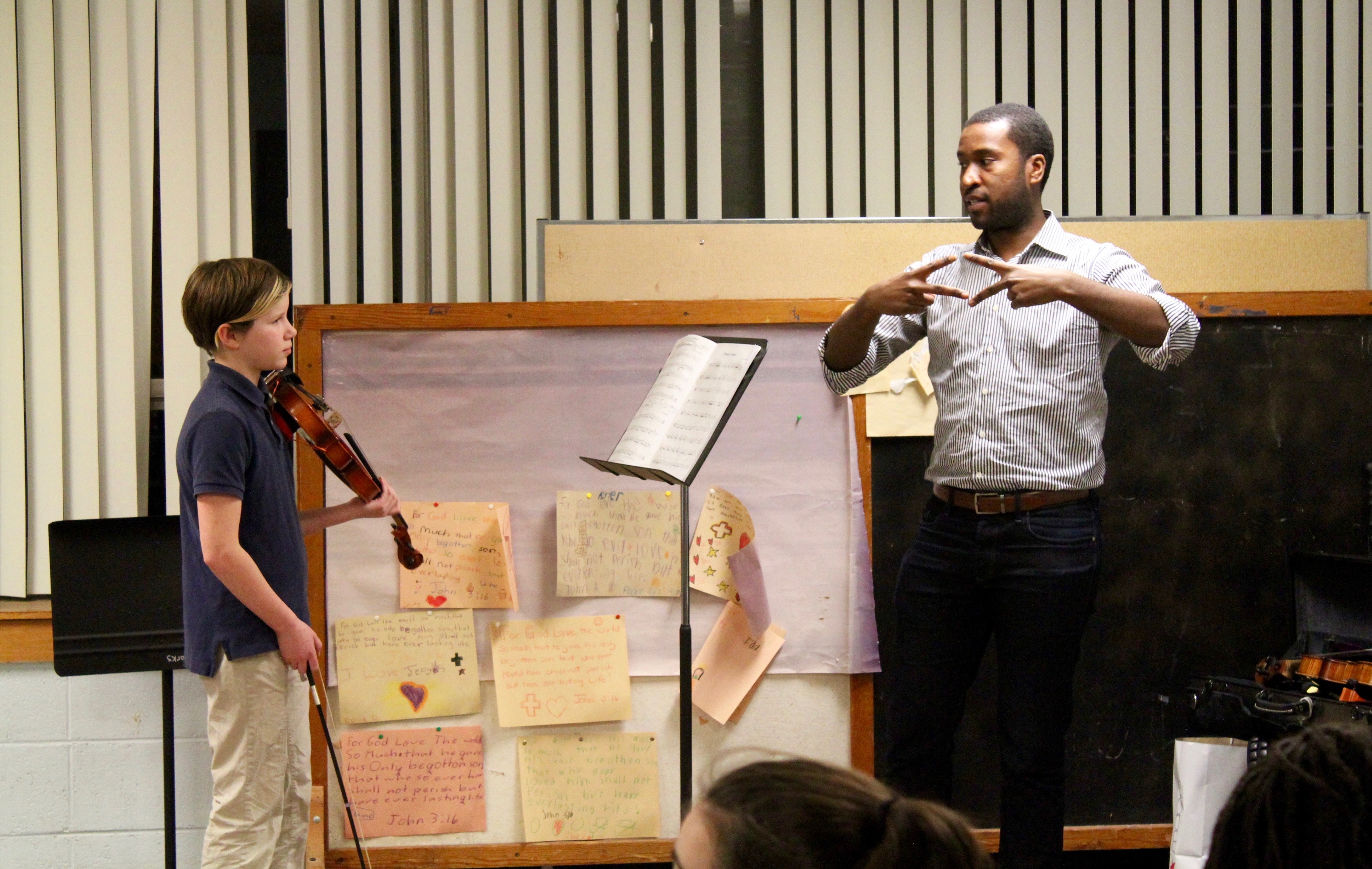
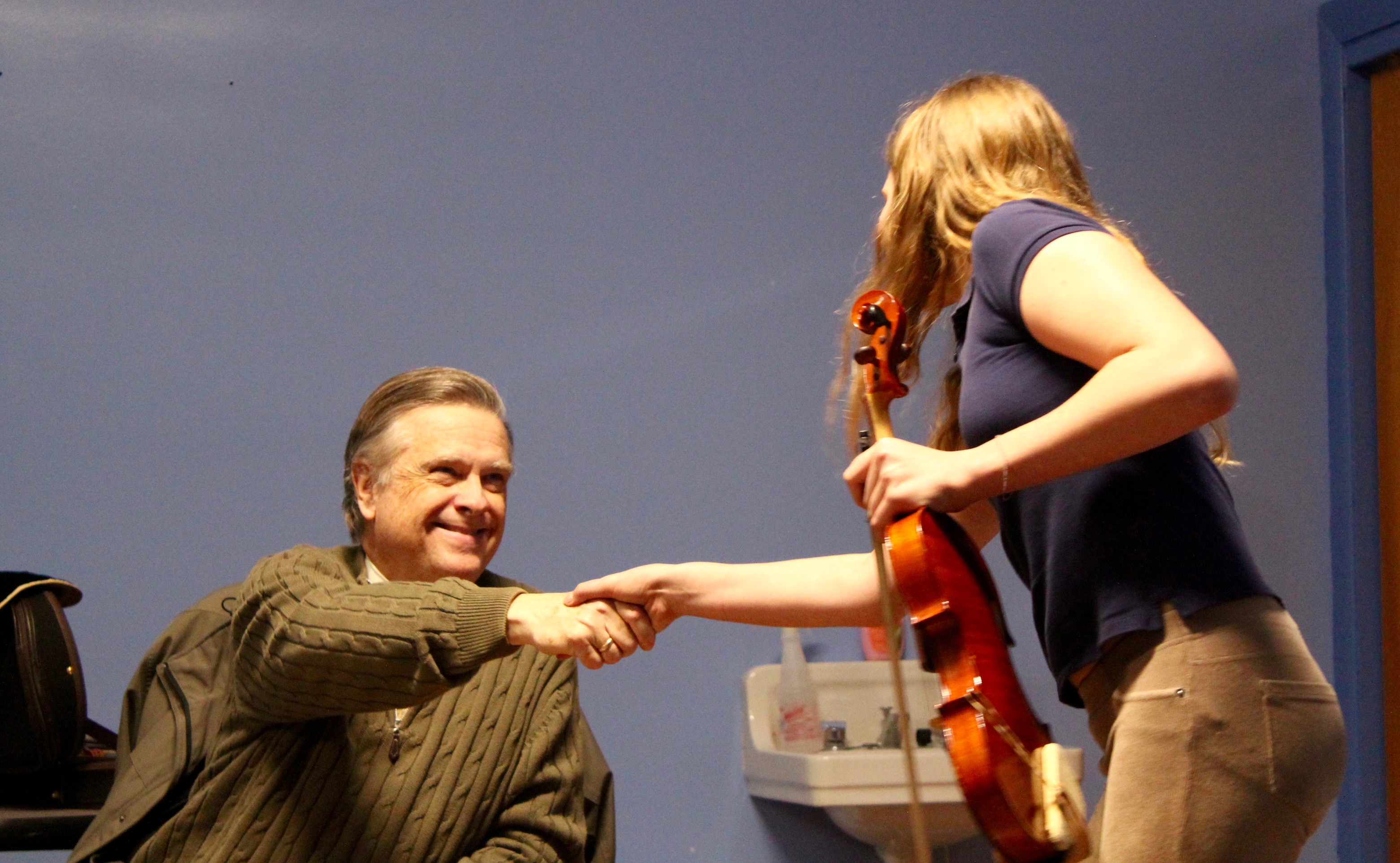
Last week during All Play Day, students participated in a masterclass with special guests: renowned violinist James Buswell, violinist Ealain McMullin (a former CMW fellow and co-director of The Newport String Project), cellist Carol Ou, and violist Jason Amos (former CMW Fellow and member of the Boston Public Quartet). A masterclass is an opportunity for students to receive feedback on their playing in front of peers. It is a great learning experience for performers and audience-members to watch a teacher in action, ask questions, and explore musical ideas together.
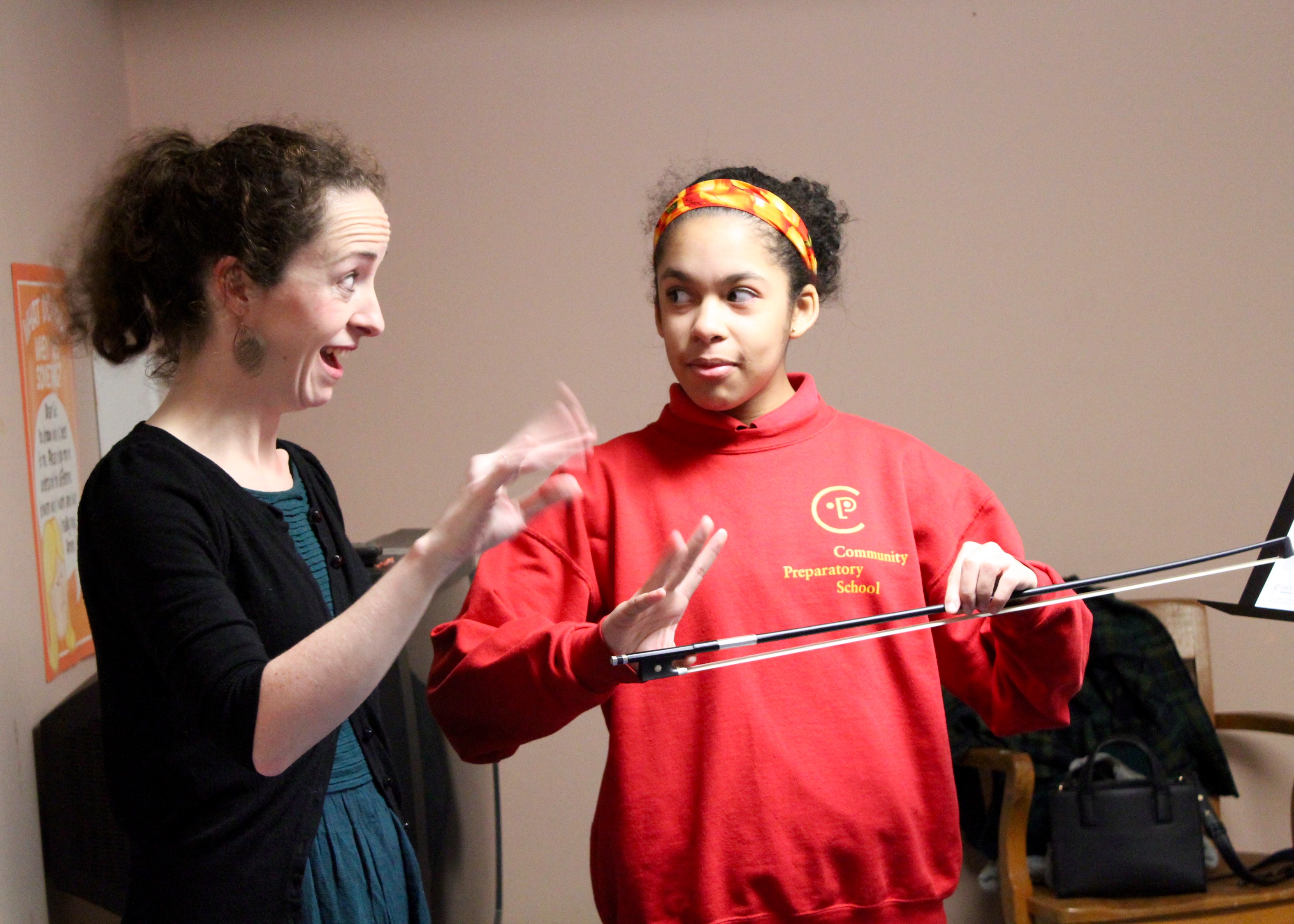
It has been particularly rewarding to follow up with students this week about what they learned from the class. My violin student Ella remarked “I learned that it’s important to warm-up with scales. I liked hearing him [Mr. Buswell] play for us.” Some students are already incorporating new ideas into their playing. It was a great afternoon of sharing and learning and we are grateful to the teachers for joining us at All Play!
–Josie Davis, Violin Fellow
I first became aware of Pauline Oliveros my first year in college (way back in 1993!). The music library at the university I attended my freshman year (U of I in Champaign-Urbana) had an extensive collection of LPs and scores by contemporary composers. This was the first time I had unlimited access to that kind of music. I don’t know how I came across her record. I think I was just flipping through the school’s massive collection and was struck by there being a woman on the cover and that she played accordion. To me, neither of these things were in line with classical music, and being the self-proclaimed black sheep wherever I go, I naturally gravitated to it. Unfortunately, I had so much studying and practicing of “standard repertoire” to do for the remainder of my education, I was unable to explore more of her music, but she was always in the back of my musical mind. It wasn’t until a decade later that I got to see her perform live as part of a sound installation in a parking garage in Santa Monica, California. She was already 72 years old at the time, eyes closed, playing accordion intently, drawing in everyone awkwardly standing around her. I was too shy to talk to her then but almost another decade later I was able to see her speak on a panel at the 80th birthday celebration of Alvin Lucier at Wesleyan University. I made a point of approaching her afterwards and telling her how much I appreciated her work. I had planned to take a trip to Troy, NY to visit her where she taught and hopefully play for her, but it never happened and sadly, Pauline Oliveros passed away at age 84 last November.
So what was so amazing about Pauline you might ask? Well, not only was she a pioneer in experimental electronic music, she coined the term “Deep Listening,” which is almost a lifestyle for some people. She even developed a new musical theory of “sonic awareness.” This awareness is described as “the ability to consciously focus attention upon environmental and musical sound”, requiring “continual alertness and an inclination to be always listening.” This is something that I have continually practiced through my improvisations and performances of experimental music and what I’ve strived to bring to events I curate. I’m not sure running across Pauline’s LP back in 1993 planted that seed, but I’d like to think that it did.
Saturday’s concert will begin with Oliveros’ Sonic Meditation, “Sonic Rorschach” followed by a performance by the MusicWorks Collective of Catherine Lamb’s “noise/tone (emergence patterns).” Oliveros’ work will draw listeners’ attention to a finite point after being deluged (or aurally massaged) by white noise for 30 minutes and then Cat’s piece will wallow in the overtones of 60 hz, the fundamental frequency of the ever present electronic hum of the modern world. A performance by my duo, Mem1, will bring these elements to a culmination with an improvisation with cello and electronics, steeped in a practice of intimate listening that we have developed over the last 13 years together.
–Laura Cetilia is a CMW resident musician and curator of the Ars Subtilior series
Please join us for this performance:
Saturday, February 4 at 8pm
159 Sutton Street, Providence
In recent months, CMW teachers have been working with students on an experiment we’re calling the We Shall Overcome Project.
In this project, all of our student ensembles are learning an arrangement of We Shall Overcome (with parts designed for varying skill levels), and learning more about the history and meaning of the song. Since September, the students have all taking part in weekly activities that explore the text, history, and power of this song, and have been starting to write their own verses based on things that they would like to overcome – in their schools, their neighborhoods, or in the world at large. One student-written verse reads: “We are all unique…we will be ourselves….bullying is not ok.”
The first performance of these new verses were performed at the January Performance Party at Calvary Baptist Church and were a great success. Now, we’ll continue to refine the ensemble performances, and also invite parents, Board members, and community members into the process. Stay tuned for information about ways to participate, including community sings. The culminating performance will be in late March, as part of the Emanuel Ax residency, and we’ll produce a video on the project this spring.
This experiment helps us explore our hypothesis that musical proficiency and community participation skills are mutually reinforcing. We hope that, through the We Shall Overcome Project, students, families, and teachers will work together to more deeply explore the meaning of music and the role it can have in supporting social change.
— Chloe Kline
Education Director
Ever wonder about the history of a particular musical instrument? The musicians it has served, the venues it has seen, the audiences reached? CMW recently received a donation of two instruments from a generous donor. In this account, Karen Romer gives us the story of Carrie Teale and the violins destined for our community of music-loving youth.
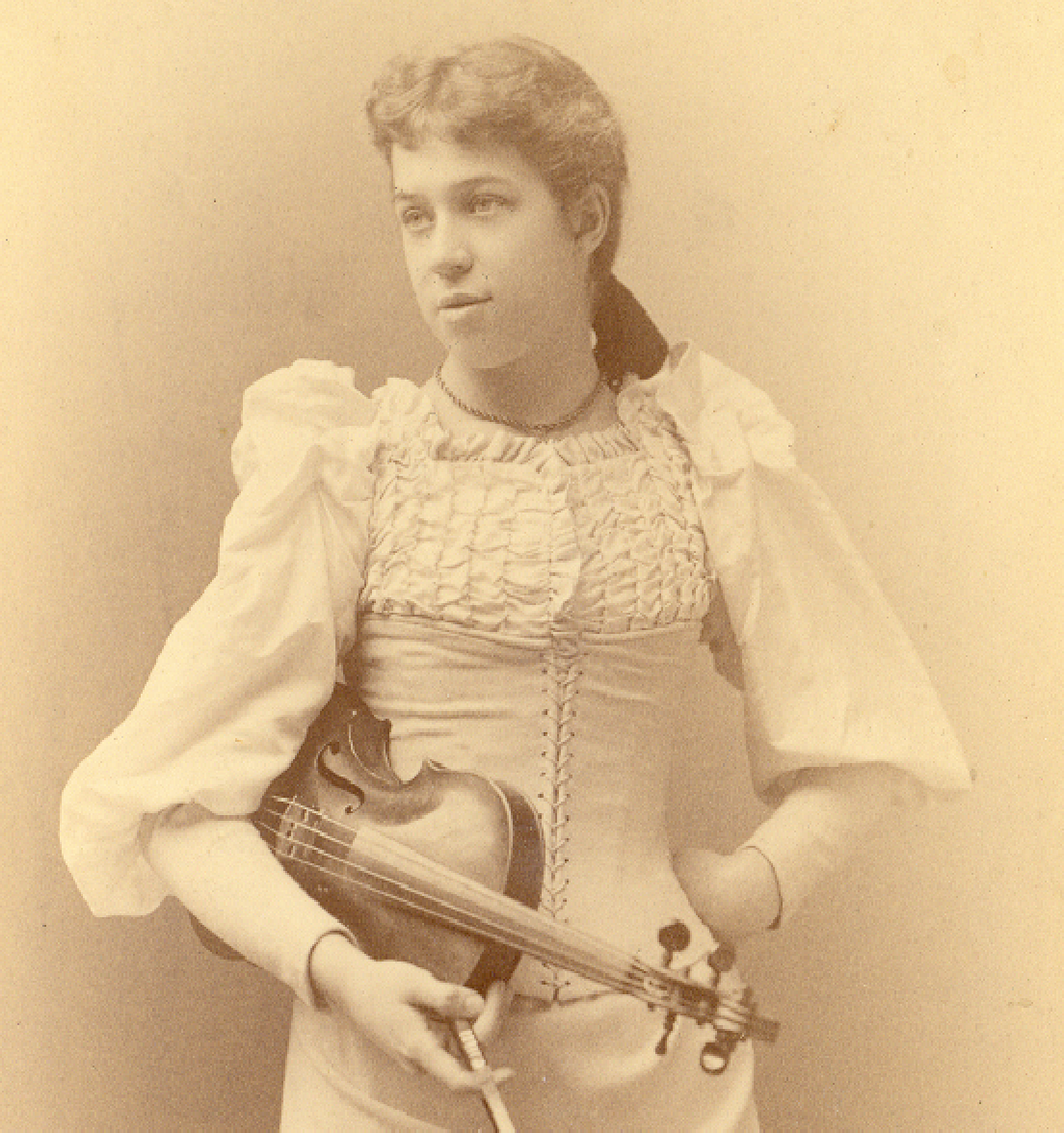
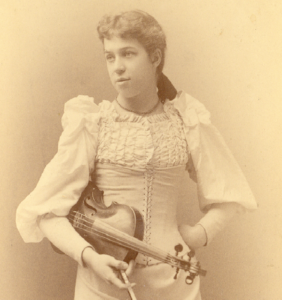 Carrie Teale Carrie Teale
It was the 1890’s and teenager Carrie Teale had a gift for music. She played the violin so beautifully that Leopold Auer, the great teacher of Jascha Heifetz and Nathan Milstein, heard her recital at Carnegie Hall and urged her parents to let him teach her in Germany. Carrie’s parents thought Germany was too far away for a girl of sixteen to go alone; however, her father wanted her to have the best possibilities in America, so he bought her a fine Italian violin.
Carrie continued to play, but not professionally. She married young and had two daughters. Chamber music and musician friends often filled Carrie’s house. Family lore tells of her second daughter, Catherine, once asking her mother how she connected with people who were strangers only minutes before, yet were soon revealing their innermost thoughts. Carrie was stopped by the question, unaware that she was anything special. “No one is a stranger,” she said.
Years later, arthritis prevented Carrie from playing even the standard folk songs and “Pop Goes the Weasel” for her grandchildren, so she entrusted her two violins to her granddaughter, Ann Chalmers Watts. “You can do whatever you want with these instruments as long as they will benefit young people,” Carrie said. Now Community MusicWorks is the fortunate recipient of those two violins. It seems the Powers That Be knew that CMW would be the perfect destination for the violins of someone who thought that “no one is a stranger”.
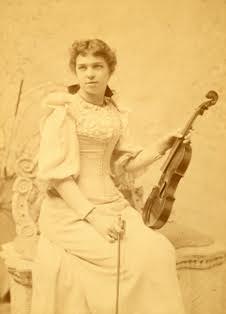
Recently some CMW students, staff and board members came together to meet Ann and see the two violins she offered to CMW. We sat around two very well worn cases while resident musician Jesse Holstein opened and unwrapped the violins, one by one, from faded yellow silk. One, the instrument that Carrie probably played for her recital, had a golden varnish and appeared to be from the 19th century and German, modeled after an Amati. The other was dark auburn and made by Ruggieri of Cremona in 1671. (That was fourteen years before Bach and Handel were born!) Jesse passed the violins around our circle, and we admired them, asked questions and made comments. A luthier will give them careful attention before restringing and setting them up for a new life in Providence.
One CMW student, Alex, observed that for hundreds of years people like herself had been excluded from the community of classical musicians and thus from the joys and satisfactions of learning about classical music through playing it; she said she is now part of that community because of CMW, and those joys are very much a part of her life, including playing Bach and “Papa Haydn.” She pointed out that she might be the first person of color to hold the Ruggieri violin.
Finally, to culminate the occasion, some people played wonderfully: Alex played Bach, student Jessenia played Mazas and fellow Josie and Jesse played duos by Bach, Pleyel, and Bartok. There is a good chance you can hear these violins in 2017!
–Karen Romer
CMW supporter and former President of the Board
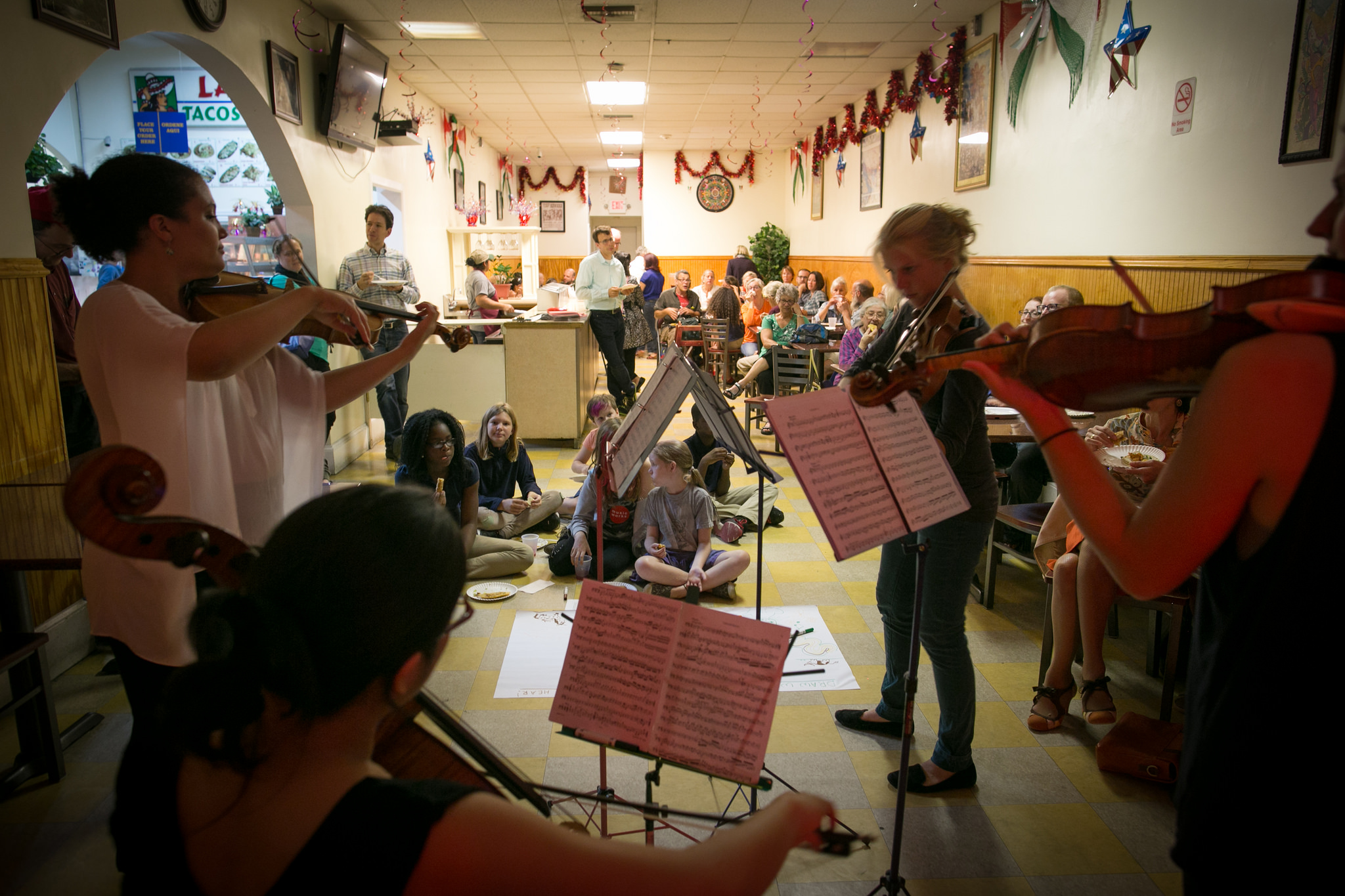
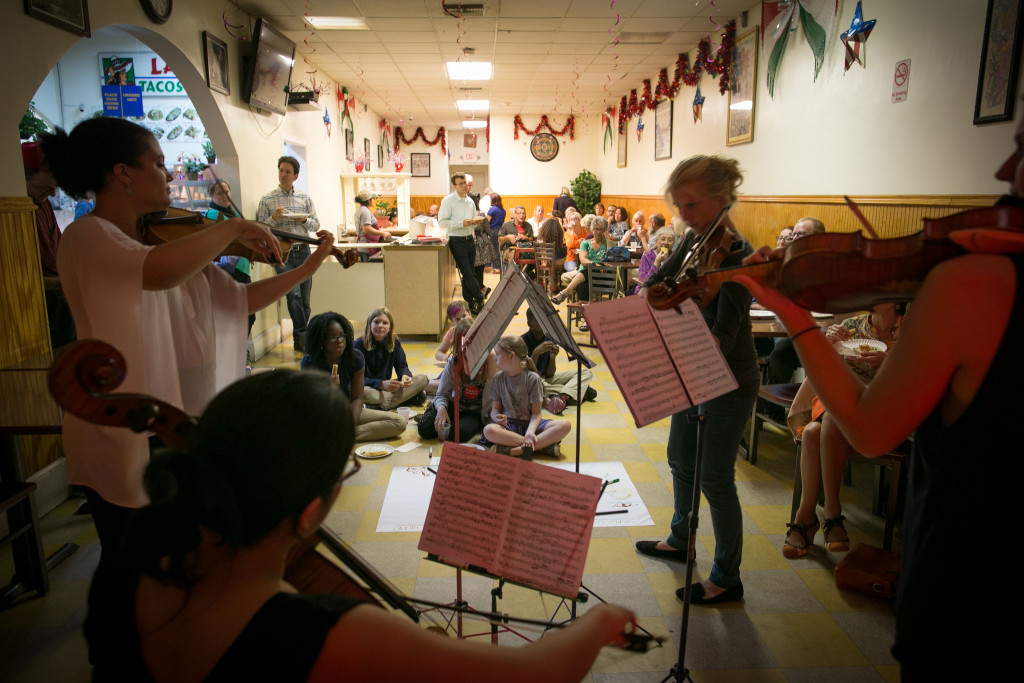
Community MusicWorks has commissioned WolfBrown, an arts and culture research firm, to evaluate the impact of our mission through various strands of our work in Providence over twenty seasons. Sharing Tables with Strangers is the second in a three-part series of publications. This report, funded by ArtPlace America, is co-authored by Chloe Kline, CMW’s Education Director, and Dennie Palmer Wolf, of WolfBrown and analyzes the ways in which CMW has had an influence on the neighborhoods in which we work, specifically through the lens of a collaboratively-produced concert series in a neighborhood taqueria.
Click here for the 2016 evaluation: Sharing Tables with Strangers
When people ask, How is Community MusicWorks going?, I find myself talking about a feeling of newness. After two decades immersed in the mission of CMW, what inspires this sense of renewal?
As we mark our 20th season, the original spark has more clarity as we draw from our lived experience of the mission. We are recommitting to aligning musical excellence with social justice: work that leads to a more just world, and in return becomes a catalyst for greater artistic expression.
Your support keeps our work in motion. The impact of your gift may resonate loudly through our performances, or more subtly through our work with our students. Over time, the effects of both have been profound.

When doing aspirational work, there is an interplay between the ideal and the real. In the beginning, the gap between the vision and the day-to-day could be so wide as to be disheartening. But that distance has narrowed. We see our vision taking shape in the activities of our musicians, students, and community members every day.
For example, as every student learns the music of We Shall Overcome this fall, they also take part in weekly discussions about the song’s history in the Civil Rights Movement. Students and their families will identify what overcoming feels like to them in their communities and how music plays a role. In this rich context of a deeper learning of music, students’ awareness of the world is changing and expanding. Their ability to discuss important issues grows more thoughtful. They are becoming citizens of the world.
Intention and effort are also coming together for us as performers. With our new ensemble name, MusicWorks Collective, we are expanding our repertoire and concert locations to reflect our vision that performances can transform audiences and musicians alike.
As we renew our mission, I invite you to also show your support and join us in celebrating our 20th season with a gift of $20, or $200 – or perhaps even $2,000.
Your generous gift directly supports CMW’s mission to transform lives, and will be felt, seen and heard in every classroom, rehearsal space and performance hall. Your support will reach every CMW musician—from faculty to student—and audience member.
I thank you for being part of Community MusicWorks 20th season, and our shared inspiration to find meaning and make a difference in our communities.
With all best wishes for the holiday season,
Sebastian Ruth
Founder & Artistic Director
P.S. Please be sure to share your email address with us when you make your donation or online at www.communitymusicworks.org/give. You won’t want to miss our monthly e-news, including special concert announcements, photos and program updates.
Make your online donation here, or send a check to:
Community MusicWorks
1392 Westminster Street
Providence, RI 02909
Reposted from the Brown Daily Herald, written by Nancy Safian.
Wednesday morning, Rhode Island National Public Radio’s political analyst Scott MacKay tweeted a link to Joe Conason’s blog post for the National Memo, “What Do We Tell the Children About Their Country Now?” As the mother of a 12-year-old and a 17-year-old who are both worried about the election outcome, I’ve been reading quite a few blog posts on this question. But what helped me the most was a meeting I attended Wednesday morning with the Providence Youth Arts Collaborative, a coalition of nonprofit organizations that offers free after-school arts programs to thousands of public school children in neighborhoods around the city.
At about 11 a.m., eight of us entered Everett’s Carriage House Theatre in Mount Hope. Sebastian Ruth ’97, artistic director of Community MusicWorks and assistant professor of the practice of music at Brown, silently took out his violin and for 15 minutes played Johann Sebastian Bach’s “Chaconne” for our small group. The reverberating sounds of his violin filled the space, sounding to me like waves of cries and sighs of loss. Ruth told us that Bach wrote the song after learning his wife had died.
We sat in silence for a long while until Anjel Newman, director of AS220 Youth, in response to the piece, read her reflections on what the election means to her as a mother and a woman of color. After that, Jan Marie, an artist at Everett Company, slowly and methodically listed all the names of the young people she works with, citing each student’s personal stories (one is gay; another’s mother recently passed away; another has brothers in jail) along with their strengths (kindness, artistry, compassion and camaraderie).
Vanessa DeNino, Americorps program director at Providence CityArts for Youth, asked the very question from MacKay’s tweet: How do we talk to the children now? Her face was etched with concern, regretful that she was not successful in convincing a middle school teacher to support an art project because the teacher was worried it was too political.
In an election when the data failed us, when the media pundits seem unmoored by what happened Tuesday, I found comfort in the people in that room. I have always been skeptical of our over-reliance on data — in education, especially — when it comes at the expense of empathy, intuition and creative thinking. In this election, I was swept away into believing that the data and polling would prove true.
But I sat in this room with seven overworked, underfunded and concerned arts leaders, and what they said in the end gave me hope. Newman was actually optimistic about President-Elect Donald Trump’s election because she believes it will now be impossible to sweep injustice, violent language and inequity under the rug. DeNino concurred that she will redouble her effort to create avenues for complex conversations on civics and social justice in school-based art classes. I found hope in Ruth’s beautifully played music and in the compassion and closeness Marie expressed toward the students at Everett.
I’m not sure what will happen next. I’m concerned about access to freedoms of expression and thought, which the young people in our communities take for granted. But I choose to remain hopeful that the creative young people in the PYAC programs along with the artists who work beside them — many of whom are Brown students — will find ways to use their art to create positive stories and images and to raise their voices with renewed energy for peace, justice and compassion.
Nancy Safian is the academic programming and facilities coordinator for the department of theatre arts and performance studies at Brown University. She can be reached at nancy_safian@brown.edu.
Our work with young people feels ever more urgent today, as so many today are feeling afraid, unwelcome, targeted. Paolo Freire insisted upon critical consciousness in considering the world around us. Young people need the tools and the experience to critically examine our current reality, to challenge the status quo, to come together with others to resist. We will be working yet harder to help young people understand that this election outcome can’t spell a new reality where racist, sexist, xenophobic rhetoric is acceptable or normal. We need to constantly insist upon and work toward the reality we seek. Now more than ever. Through music, through dialogue, through the pursuit of diverse and supportive community, we will dig in and work harder, with love.
–Sebastian Ruth
“Twenty years ago, CMW virtually founded the field of place-based music making with an emphasis on social justice in the U.S. Two decades later, their original values and practices show up in the mission statements and goals for virtually every community embedded music education program – Sistema-inspired and others. But what doesn’t show up in those other programs is the deliberate program design and the hard work of implementing the design in daily practice. That is where CMW’s excellence and value to the field lies. But that’s also the challenge – on the one hand, CMW’s vision has been normalized. On the other hand, what remains unique – daily hard work and evolution – isn’t as glamorous as high-minded promises.”–Arts Educator and Author Eric Booth, from the 2016 Evaluation of CMW’s “Extending Our Reach” Initiative
As Community MusicWorks celebrates its 20th season, we are pleased to present “We Are Each Other’s Magnitude and Bond,” a report that focuses on CMW’s efforts to share our model and practices over the past decade.
We Are Each Other’s Magnitude and Bond is an evaluation of Community MusicWorks’ Fellowship Program and Institutes for Musicianship and Public Service — two long-term efforts funded by the Andrew W. Mellon Foundation designed to extend the impact of CMW’s twenty-year urban music residency to a wider field. Led by Wolf Brown’s Dennie Palmer-Wolf of WolfBrown, the evaluation documents the effectiveness of the Fellowship Program and Institutes in diversifying the classical music field, promoting the uptake of CMW’s model in new communities, building supportive networks, and developing a next generation of entrepreneurial, community-invested musicians.
|
|