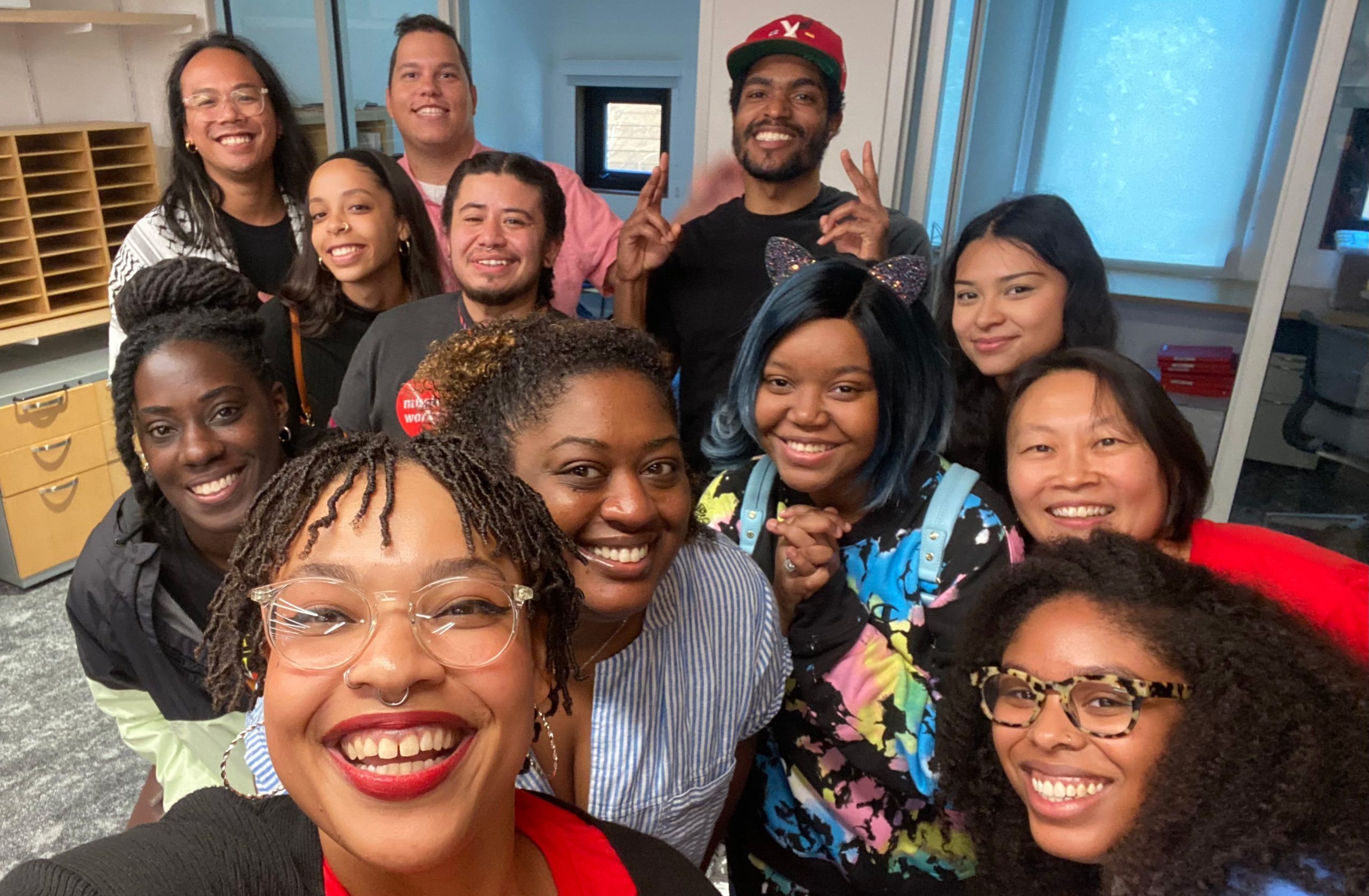
Lauren Latessa, recent Fellowship Program graduate, sums up her experience at CMW over the past two years:
I clearly remember the first time I heard about Community MusicWorks’ Fellowship Program. I was in the music library at Peabody, and a friend emailed the link with the subject, “this would be perfect for you”. It was around this time that I was realizing a traditional music career was not for me. Instead of devoting all my time to refining my technical abilities, I wanted to also address those questions that keep musicians up at night. Questions like: What is the point of our artistic endeavors? How can we make this music relevant to a new generation? What is a musician’s role in society? Even from that first email, I could see that CMW was an organization actively involved in addressing those questions. So I started following CMW. I scoured the website and read all of Maxine Greene’s philosophy. I celebrated Sebastian’s well-earned MacArthur award and I read the blog when the students traveled to Washington D.C. Eventually I came to Providence to attend CMW’s Institute for Musicianship and Public Service (IMPS). By the time I came to IMPS I was in love with the organization and mission. While my colleagues at school dreamed of landing that amazing orchestra job, I dreamed of becoming a fellow at CMW.
My first few months in Providence were pretty surreal. It was shocking how much time I spent moving chairs, packing snacks and setting alarms. I came with my lofty questions, but quickly learned that lofty questions are only answered through grit, hardwork and silly details. At first I couldn’t see the relationship between this day-to-day grind and my questions. Then, slowly my students opened their lives to me. Their parents became my friends and I learned their stories. I played my first concert at RISD and developed relationships with CMW’s wonderful board members. I began to understand the inside jokes at staff meeting. I coached the Sweet Potatoes, an adult amateur trio comprised of CMW board members and parents. Through these experiences, the many layers of CMW’s community became clear to me. As my time at CMW went on I continued to see the versatility, depth and strength of this community. From watching our students interact with each other, their families and faculty it became clear to me that the power of this community was much greater than any of its individuals. The most powerful example of this was the performance of Gonzalo Grau's "Fantasia de Guayaba Habanera". The rehearsals the week before the performance were some of the most focused and exciting rehearsals that I’ve been in. Our Phase II students, the CMW Players and all of our incredible guest artists rose to the challenge of the piece and created something magical that we never could have achieved as individuals.
The ending of this fellowship was just as surreal as the beginning. While the reality of my two years here didn’t always live up to my fantasy, every moment helped me chase those questions that have thus far defined my career. No two days were ever the same! The silly details never went away, but I was continually energized by the people around me. I think back on my questions and I am so excited by what CMW has shown me. This is a place that promotes joy, understanding and acceptance. In a world where we are often defined by our differences, CMW looks for our commonalities. At CMW, classical music is our common thread. It connects us to each other in ways we did not think were possible. That gives more meaning to my profession than I could ever have hoped for. Thank you CMW community for welcoming me in and showing me this possibility! I will miss you all!
–Lauren Latessa, Cello Fellow '12-'14

CMW Fellowship Program grad Annalisa Boerner (viola '12-'14) gives us some parting thoughts, and a new mash-up word for our lexicon: listicle, a combination list and article.
I had no idea where to start my end-of-fellowship post, so I decided to be very 2014 and go with a “listicle.” The following are six menu bar options from the current CMW website, and I found that I had something to say about each one:
1. About Us
CMW, as a staff, is a group of individuals who share and collaborate even as they retain their creativity and individuality. CMW, as a student body, is much the same. The organization is deeply committed to mutual learning about and with everyone it touches. The learning we do, the performing we do, and the relationships we build are all in service of a mission that is about the agency and potential and value of each community member… or, “about us.”
2. Programs
I have done an immeasurable amount of hands-on learning through participating in CMW’s many programs. I’ve also had the opportunity to experience the genesis or evolution of various initiatives (a process that is at least as educational as the participation). CMW isn’t afraid to experiment, to evaluate, to pilot, and to refine, as long as it is still striving toward its core values through these multifarious efforts.
3.Calendar
What a dense calendar it is! The Fellowship is a good way to figure out just how polished one’s time management skills really are. The CMW year is packed with educational opportunities for the kids (outdoor retreats, casual and formal performances, concert trips), performance opportunities for the faculty (in museums, gymnasiums, various underused properties), professional development (networking, teacher training, seminars), sundry tasks (staff meetings, cleaning out the quartet studio, filling out paperwork and contracts) and the occasional margarita night. Is there a stronger word for “dense?”
4. Media
The CMW Flickr account is like a magical play-by-play. It amazes me due to the beautiful photographic evidence of my time here, because it is fascinating to see how far I’ve come, and because given those parameters I am still blown away by the number of events and projects that transpired without documentation (see: Calendar).
5. Get Involved
CMW has created a unique environment that can help its musicians be fully involved in its proposition. They can create multifaceted careers within the same Providence space, and know that they are surrounded by people who share their values. This amalgamation of roles (teacher, performer, administrator, connector) in one place and under one philosophical umbrella allows the professional musician to “get involved” in the work in a special way.
6. Contact Us/Home
CMW has pulled together a remarkable set of people and values, and I trust that they will be a key part of my musical and personal life for decades to come. I feel fortunate be in contact with this extended family, and it’s hard to express how lucky I am to have called this place home.
Thank you, CMW, for everything.
–Annalisa Boerner

Experience The Sounds of Business as CMW Founder & Artistic Director Sebastian Ruth chats with host Sy Yule about the Community MusicWorks programs and his motivation to start the organization.
Listen to Sebastian's interview here.
Here at CMW we are celebrating the exciting news that we've been selected from among 1,270 applicants nationwide as one of 55 organizations to receive a major grant from ArtPlace America!
This award will be CMW's second grant from the program, having received one in 2012 from a similarly large field of applicants. With support from ArtPlace America during 2014-15, Community MusicWorks will expand its work by transforming its headquarters into an outward facing public space with deep community ties, as well as developing sustained partnerships with two nonprofit housing developers, S.W.A.P. and Olneyville Housing Corporation, to activate a decentralized network of storefront art spaces in the low-income communities of South Providence, the West End, and Olneyville. This work will include lively musical happenings on the streets and sidewalks, storefronts, restaurants, and other underused community spaces, bringing people together, enlivening public spaces, and strengthening community ties.
"We are honored to be included in this group of compelling projects nationwide. This award will have a catalytic impact on our ability to advance our longstanding work to bring people together through music, to make our communities stronger and more vital," said Community MusicWorks’ Founder and Artistic Director Sebastian Ruth.
CMW will be participating with five other grantees nationwide to build a learning and leadership cohort of partners in the performing arts within the field of creative placemaking. This work is an extension of CMW's longstanding work to share its successful model of neighborhood-based music-making with other musicians and arts organizations across the country, through a two-year fellowship program, conferences, and regular institutes.
“Investing in and supporting the arts have a profound impact on the social, physical, and economic futures of communities,” said ArtPlace Executive Director Jamie L. Bennett. “Projects like these demonstrate how imaginative and committed people are when it comes to enhancing their communities with creative interventions and thoughtful practices.”
Providence Mayor Angel Taveras said of the award, "The City of Providence applauds Community MusicWorks for its longstanding commitment to the betterment of our city, engaging young people and their families in imagining a better future through the arts. We are pleased that the national funders represented by Art Place have recognized their meaningful work in our city for a second time."
"Funding the arts is a good investment for our communities and our economy," said Senator Sheldon Whitehouse, an ex-officio member of the National Council on the Arts, the advisory body of the National Endowment for the Arts. "Congratulations to Community MusicWorks on winning this important support."
About ArtPlace America
ArtPlace America (ArtPlace) advances the field of creative placemaking, in which art and culture plays an explicit and central role in shaping communities’ social, physical, and economic futures. To date, ArtPlace has awarded $56.8 million through 189 grants to projects serving 122 communities across 42 states and the District of Columbia.
ArtPlace is a collaboration among the Barr Foundation, Bloomberg Philanthropies, The Ford Foundation, The James Irvine Foundation, The John S. and James L. Knight Foundation, The Kresge Foundation, The McKnight Foundation, The Andrew W. Mellon Foundation, The William Penn Foundation, The Rockefeller Foundation, Rasmuson Foundation, The Surdna Foundation, and two anonymous donors.
ArtPlace seeks advice and counsel from its close working relationships with the following federal agencies: the National Endowment for the Arts, the US Departments of Housing and Urban Development, Health and Human Services, Agriculture, Education, and Transportation, along with leadership from the White House Office of Management and Budget and the Domestic Policy Council.
ArtPlace has additional partnership from six major financial institutions: Bank of America, Citi, Deutsche Bank, Chase, MetLife and Morgan Stanley.
For the Spring issue of Music at Yale, Sebastian Ruth talks about his exploration of this question as Visiting Lecturer in Community Engagement at Yale School of Music, saying, "a musician's output is not for the sake of the art form, but for the sake of humanity."
Read Sebastian's piece here.

Things have been busy at the Daily Orchestra Program! From learning the story of Johann Sebastian Bach’s life (in three action-packed installments, complete with cliffhangers) to performing two concerts, our students have had no shortage of things to do and music to learn! As usual they have been embracing it all with enthusiasm, and as we draw closer and closer to the end of the school year the fruits of their hard work are starting to show themselves in exciting ways.
We spent much of this semester preparing a full program of music, including four short pieces. The first-year Britten Orchestra worked hard to improve their bow holds and instrument posture and showed off their ease of playing their open strings with the boot-tapping favorite “Tuning Hoe Down.” Meanwhile, the second-year Beethoven Orchestra learned some new, more advanced left-hand finger patterns in order to play a pizzicato bass line for the D-jam Blues (our rendition of Duke Ellington’s C-jam Blues). This meant that the Beethovens actually filled in the role Adrienne Taylor played for them last year, while the Brittens took over for the Beethovens. We also added to the program a cute song referencing the Grimm’s Fairy Tale “The Elves and the Shoemaker,” and last but not least the classic theme from the William Tell Overture by Rossini.
We were lucky enough to have two opportunities to perform our repertoire. On the last day before spring break we turned our room at Federal Hill House into an auditorium and presented to families and staff members a full half-hour of music, complete with solo performances! There were feelings of pride and happiness emanating from all corners of the room, and we sent everyone off for spring break feeling victorious!


After spring break we returned to perform the same program again (just like a professional orchestra might do!) at a special event for the Olneyville Housing Corporation. Our students were calm and poised in the face of flashing cameras and chatting event-goers, and their families, anxious not to miss a single moment of the performance, crowded the stage and filled the air with support and cheers after each number.
Now we are in the final stretch to the end of the year, and we are working on some exciting projects. We’re also learning about the life of Ludwig van Beethoven, while we learn to sing and play his famous melody Ode to Joy.
— Lisa Barksdale

Maxine Greene has died. My interactions with her set me on the course I am on, and the career I have had.
In 1995 I heard Maxine speak at the Coalition of Essential Schools Fall Forum, and her fresh approach to articulating the intersection of arts, education, and social change provided a huge opening in my thinking. Releasing the Imagination was published that year, and it became a bible for me in my academic work, and in forming ideas for what became Community MusicWorks.
Maxine was an embodiment of the living philosopher—her ideas weren’t static, but lived, examined, reviewed, discussed. And, unlike some brilliant thinkers, Maxine was truly present and human—not lost in ideas only. It was the latter quality, the familiar Jewish Brooklynite that led me to introduce her to my grandmother over dinner at “Busby’s” in Maxine’s neighborhood—two women, born in the ‘teens, who embodied the culture from which they came, but also transcended the times. Both boldly moved through gender barriers and became women leaders—in Maxine’s case by breaking into the world of professional academic philosophers, and in Grandma’s case by moving to Manhattan and living the last chapter of her life as a city girl, working, going to school, taking in the cultural life and more. (For years afterward, Maxine would try to remember how we had first met…”was it your grandmother who introduced us?” she would ask.)
What an honor when Maxine accepted my invitation to come to Providence to speak at a conference we held here, whose purpose was to further build the community of artists and educators who were applying her ideas, albeit with baby steps by that point, in 2000. Then again, in 2008, when I could proudly tell Maxine that we had built the “community of educators committed to emancipatory pedagogy, particularly in the domain of the arts.” (from “Texts and Margins,” in Releasing the Imagination.)

And then there was Maxine’s living room, the venue for so many magical discussions, visits, and salons, including one in which our quartet performed. Maxine would describe for years after, the transformation she felt, looking at the trees in the park across Fifth Avenue from apartment 3C, as they had never appeared before—how the music transformed even her view of daily life. How many people, devotees, students, august leaders, sat in that living room?
I remember talking with Maxine on many occasions about Paolo Freire, whose work is another bedrock inspiration for CMW and countless other educational initiatives. “Yes, I loved Paolo. I remember the birthday party I threw for him…” For Maxine it was like that. Friendship, love, humility—never aware of her own stature as among the pantheon of gods who inspire us.
It’s always an unfinished conversation. She taught us that. It’s a community in the making, a process of always becoming, never arriving. It’s never static, and we should fear someone who says it is.
It’s that quality that makes her death devastating. Of course, at 96, we can say it was a full life, well lived. But, I have never felt finished as her student. The world is emptier without being able to stop by and ask what she thinks of the latest news, the newest angle on the problems of education, of arts, of encouraging young people to imagine.
Thank you, Maxine, for a lifetime of inspiration. We’ll carry on for you, and in that honor you, with great love.
– Sebastian Ruth
Read the transcript of Maxine Greene's 2008 talk at the Imagining Art + Social Change conference here.
Watch the video of Sebastian's interview of Maxine Greene for the 2011 Music & Civil Society symposium here.

Yesterday afternoon, several CMW students who are also students at TAPA (Trinity Academy for the Performing Arts) helped organize and participated in a neighborhood rally for peace, held at the Armory. They also performed on bucket band, alongside the Extraordinary Rendition Band and other community members.

CMW student cellists played at CityFarm's annual Plant Sale this past Saturday. Each student was generously gifted with their own plant to take home and plant!

The CMW Symphony was in fine form last night, rehearsing the CMW Round/Michael Nyman mash up for the year end Gala performance on May 27 at the Roger Williams Casino. We had all the parts together for the first time last night, and our fearless leader, Chase, worked with us on hearing all the parts together, making a more gritty sound together, and cutting off together.
(Theme of the rehearsal: TOGETHER!)
Join us!
Year End Gala Student Performance
Tuesday, May 27 at 6 pm
Roger Williams Park Casino, Providence
|
|