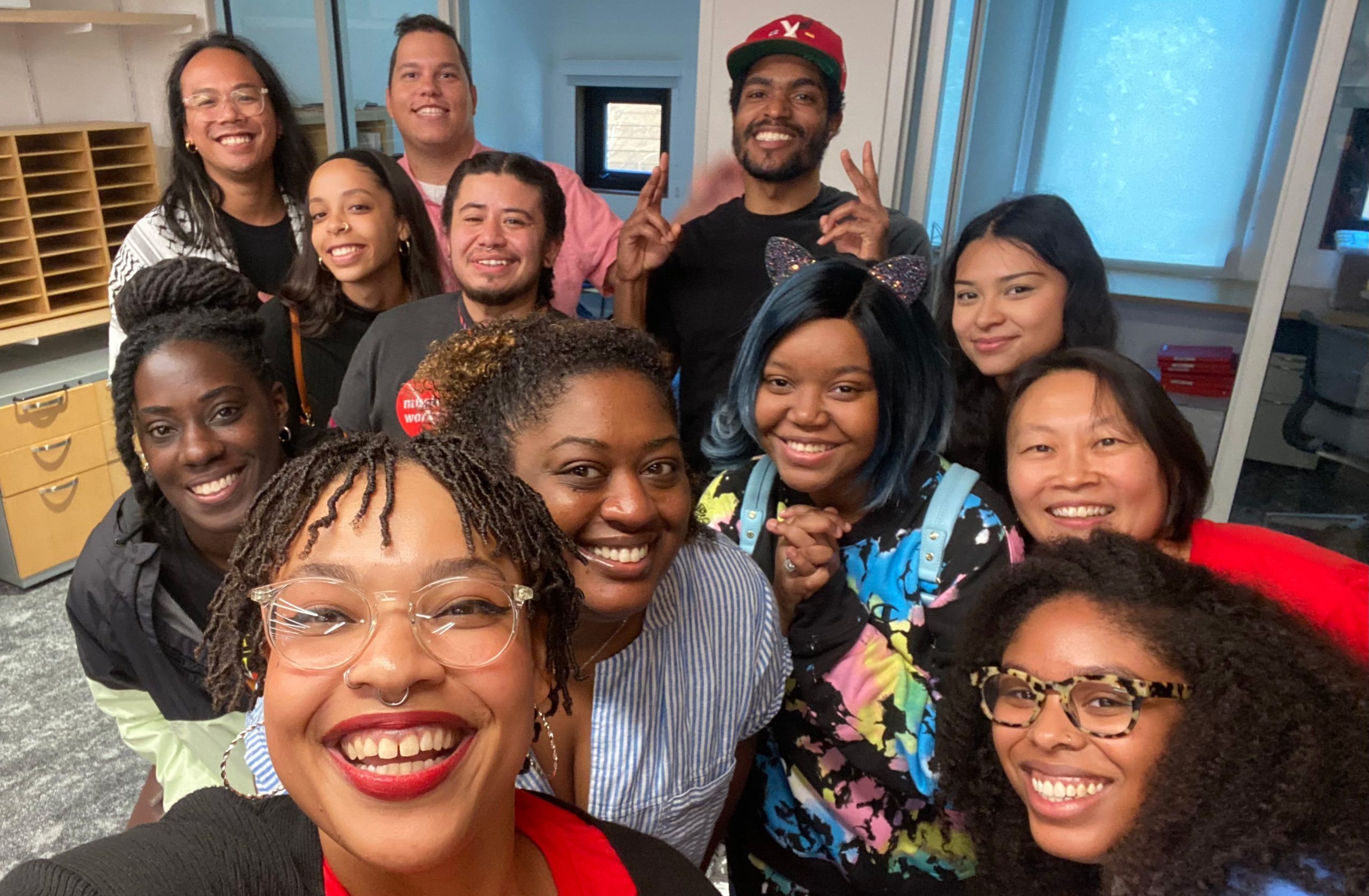
For students and staff alike, it has been another magical, whirlwind of a year with trips to Washington, memorable musical performances, as well as a prestigious fellowship from the MacArthur Foundation for our founder. As the season comes to a close and we gear up for our final activities, put student instruments in storage for the summer, send students off to various music camps, and plan schedules and events for the upcoming year, I’m pausing to reflect on my experience within this remarkable organization over the past ten years.

As a member of the Providence String Quartet since 2001, I have witnessed extraordinary growth and transformation with our students and families. All of the students that have stayed with us through high school have gone on to attend college, some even choosing to pursue music. Many of our families have volunteered countless hours and boldly taken on Friday afternoon traffic on Manton Avenue to get their kids to All-Play Day because they too believe in this ongoing experiment called Community MusicWorks.

Our mission statement reads, “To create a cohesive urban community through music education and performance that transforms the lives of children, families, and musicians.” It is perhaps easy to overlook the last two words, “…and musicians.” CMW is not only about the transformation that takes place for our young participants and their families, but also about the personal growth that occurs within our own staff and the many friends in our constantly growing—and increasingly international—network of professional musicians.
Leaving the New England Conservatory in 2000, I had worked hard on my violin playing but was unsure if that meant anything. The allure of pursuing a cushy orchestra job was tempting, but when I was approached by Sebastian about joining CMW, I was intrigued because it seemed to encapsulate three ideas that interested me: string quartets, teaching, and social justice.

Providence String Quartet (2001)
After my first year in Providence with a few growing pains (you mean I should keep a planner?), I can honestly say, here in 2011, that being a part of this incredible experiment for ten years has been more musically and spiritually nourishing than I possibly could have imagined. CMW has transformed my life forever.
While there are many, many highlights over the last ten years, I want to share two distinct memories that demonstrate just how musically and spiritually nourishing this past decade has been for me. First, a particularly powerful moment from this past October was performing Jessie Montgomery’s “Anthem” in Washington with my colleagues and a group of our teens, just steps away from the site of the future Martin Luther King Jr. memorial. This moving experience reaffirmed my belief that music can be an aesthetically beautiful and powerful form of activism.

Another highlight for me was the Providence String Quartet’s “Dvořák Walk” in January 2008. We had prepared a program around Antonín Dvořák’s time in America, when he was the director of the National Conservatory of Music. After performing the program in Providence, we traveled to New York City’s Lower East Side to perform at the Third Street Music School Settlement (an institution that dates back to the era when settlement houses were important hubs of local communities). Later that day, we visited Dvořák’s home, the building that contained the now defunct Conservatory, and finally a park that hosts a bronze bust of the Czech composer. This historical excursion was meaningful to me because Dvořák himself was a passionate musical activist; he encouraged minorities to apply to the National Conservatory and waived tuition for those who could not afford to attend. He was also one of the first composers to recognize the power and beauty of the Black spiritual and Native American music. In fact, the two genres greatly influenced the music he composed while living in America.

Many years ago, when I was applying to college, I received a brochure from Oberlin with an image of the Earth on the cover and a question posed above the planet, “Think one person can change the world?” At the bottom was the answer, “So do we.” I remember thinking how idealistic and naïve this seemed to be. While I remain skeptical about my own singular impact on the world, with my amazing colleagues, our wonderful CMW families, and strong supporters like you, I am starting to believe that one organization can change the world.

During this transition from spring to summer, our work to transform our community continues unabated. So does our need for your financial support.
I hope that you will give as generously as you are able, and I look forward to creating new highlights to share with you next season.
Thank you for supporting Community MusicWorks!
-Jesse Holstein, Senior Resident Musician
To make a secure online donation, please click here or on the icon below.


More photos by Jori in CMW's Flickr account.
Drawing inspiration from Eric Booth's two-day residency earlier in the semester, CMW resident musicians have undertaken teaching experiments of their own creation during March and April. At a recent staff meeting, Minna candidly shared her teaching experiment, including its frustrating results, and then very generously agreed to write up the details for the blog.
Minna's Experiment
Questions: Are students more engaged and excited if they get to be “in charge” of their learning? Will it impact their enthusiasm for a) coming to lessons, and b) practicing during the week?
Experiment: Each week in their lessons, let them help me create the lesson plan for the day, including something they want to do. Together, come up with the list of things that they are going to work on over the week for their practice charts.
Collecting evidence: Keep a log of what the lesson was like, whether the students were more or less engaged; ask and record how much practicing they did over the course of the week.
Results
What I expected: I expected that students would have ideas about what they did or didn’t want to do in lessons, and by having the chance to be more in charge of their own learning, would feel more intrinsically motivated.
What happened: I ended up doing this primarily with my Phase I students, and only one of my Phase II students. Among my younger students, most of them didn’t really know what they wanted to do in the lesson; I think they weren’t used to being asked (or in some cases they didn’t care). Early on, my questions would be met with a shrug or “I don’t know.” So I would primarily shape the lesson, but then ask them questions to get their opinions (i.e. what kind of bow stroke should we try this scale? What tempo should we try the note reading? Where should we start in a piece? How many times should we repeat something?) Usually that succeeded in drawing the students out so that they felt more comfortable voicing their opinions and consequently felt more engaged in the lessons. In one particular student’s case, by the third week, he knew right away what he wanted to do.
However, this didn’t seem to affect how much practicing they did over the week. And even a fun lesson the week before didn’t seem to carry over to the following week’s lesson—they would come in for the lesson with blank, long faces, and sometimes noncommittal shrugs when I asked them how they were. And I would have to start all over again. I gave up asking about their home practice, because it really didn’t seem to change at all. Some weeks, I found myself very frustrated with this aspect…
Mini-success story: "D" has been really unengaged the whole year, even if I try to engage him by letting him choose pieces, etc. He seems a little stuck by the note reading thing because it slows him down. He can learn a piece much faster by ear, but we’ve been persisting with the note reading. Every lesson, when I would ask what he wanted to start with, he would shrug. In conversation one day, I was asking him what he liked, and he told me about this TV show “Minute to Win It” where you have to do something in under a minute to win a prize. So we started doing that with his note reading flashcards (17 of them). His dad was the timekeeper. We started on April 14th and at first, he could only get about half of them in a minute. Then as we continued to do it week-to-week, he got more right. Finally, he got them all in a minute, and had the biggest smile on his face at the end of it! I had never seen him so animated.
Analysis
Looking back, I realized my frustration came across in the way I was teaching and made the lesson not fun for both the student and myself. But it leaves me with the following question: How do you come in with an open mind and heart, and a smiling face when a student a) doesn’t seem to care at all, b) hasn’t touched his/her instrument since the last time you saw him/her, and c) you’re treading water and teaching the same thing over and over again?
What I learned: It takes a lot more to ignite kids’ intrinsic motivation, especially when there’s not a lot there to begin with. It’s not enough to let them choose the material (pieces) and help direct the lesson. And perhaps it’s something that builds over time—as they experience a sense of ownership in lessons and continue to have fun in their lessons, do they become more invested?
Overall, the experiment made me pay more attention to where each student was when they came into the lesson. And I made an effort to meet them where they were, and then build on that. Regardless of what intrinsic motivation they have, students always come in with something on the brain, maybe something bad happened at school, or they just got yelled at by their parents, or something else is going on for them…For pretty much everyone, it was the interpersonal connection that I made that helped us to make the material more interesting. It made me more alert as a teacher to try to really see the student—and not just focus on pushing my own agenda.
-Minna Choi, Fellowship Program Director/Resident Musician
On Friday morning, June 10, Sebastian will give Wheeler School's commencement speech. Dan Miller, Head of School, invited him to address Wheeler's graduates. CMW graduate Josh Rodriguez, home after his first year at Guilford College, will join Sebastian for a performance as part of the address.

Karl, Natasha, and Matthew performing at a fundraiser for Classics for Kids Foundation.


CMW will be presenting at the Free Minds, Free People conference in Providence, July 7-10. This amazing bi-annual national convening brings together teachers, high school and college students, researchers, parents and community-based activists/educators from across the country to build a movement to develop and promote education as a tool for liberation.
FMFP seeks to "develop ways of teaching and learning both in and out of school that help us to build a more just society." The conference is a "space in which these groups can learn from and teach each other, sharing knowledge, experience and strategies."
Early bird registration rates through June 1. Learn more about the conference here.

Congratulations to Liz Cox, a member of this month's graduating class of the University of Rhode Island! Liz earned summa cum laude honors in psychology, picking up the President's Award (for having a perfect grade point average during her tenure at URI) along the way. Next stop: a graduate degree in social work at Rhode Island College.
WASHINGTON, DC – In an effort to support the arts and promote art education and community art programs throughout Rhode Island, the Congressional delegation announced on May 16 that five local arts organizations will receive $827,800 in federal funding through the National Endowment for the Arts (NEA).
“At a time when budgetary pressures are causing cuts to many community arts programs, this federal funding will help support local non-profits and boost economic activity. Rhode Island’s creative industry enriches our cultural heritage and helps generate revenue for local communities and businesses,” said U.S. Senator Jack Reed, who, as Chairman of the Appropriations Subcommittee that funds the NEA, helped provide $154.7 million for the arts in the 2011 budget. “As we just saw with the recent budget battle in Congress, there are some who do not recognize the value of these programs. I was determined to beat back the draconian cuts being proposed and was happy that we were successful.”
“Our rich artistic tradition in Rhode Island not only contributes to our quality of life, but supports thousands of jobs. This funding will help ensure our artistic community continues to thrive,” said U.S. Senator Sheldon Whitehouse, who brought NEA Chairman Rocco Landesman to Rhode Island in February for a tour of the local arts community. Whitehouse also serves as an ex-officio member of the National Council on the Arts, the advisory body to the NEA.
“The arts industry is an important economic driver in Rhode Island,” said U.S. Representative David Cicilline. “These critical funds from the National Endowment for the Arts will support the work of the Rhode Island State Council, Rhode Island Philharmonic Orchestra & Music School, Community MusicWorks, FirstWorks and Everett Dance Theatre; five organizations that are helping to fuel our economic recovery, teach our children, and expand our civic discourse during these trying economic times. I know first-hand the benefits of arts in enriching our communities, and will continue to fight to protect the important progress we have made in the arts industry.”
[Source: Press release from the office of Senator Jack Reed.]

Free! Presented by Brown's Cogut Center for the Humanities. Details here.
|
|