Blog

New Year’s News

Perf_party_wecc

Happy 2008 to everyone!

While the Providence String Quartet and Minna spend the week on rehearsal retreat in an extremely beautiful northern location (hint: think mountains, skiing, elk), here are a few tidbits to share from Providence:

1. Remember all the commotion about Gustavo Dudamel and El Sistema? (If not, see my November post.) WGBH has posted audio from the panel discussion at the New England Conservatory which includes Sebastian, Mark Churchill, Steve Seidel, and a number of other folks who have interesting things to say about whether/how El Sistema might conceivably work in the US. Moderated by Eric Booth, who you hear very skillfully greasing the wheels of the conversation and keeping the energy level high.

2. Pianist and CMW adviser Jonathan Biss released a Beethoven CD in October that is wonderful. Check it out here. Speaking of Jonathan, did you hear his performance on Saint Paul Sunday almost a year ago?

3. Is everyone aware of Music Haven, the neighborhood-based program in New Haven, CT, inspired by Community MusicWorks and run by the Vinca String Quartet? Their inaugural Performance Party on December 16 was reportedly a big success!

4. Kudos to the Interaction Institute for Social Change. Gibran Rivera visited CMW in the fall to facilitate a fantastic full-day staff workshop that still lingers in our minds…

5. There’s a new Providence String Quartet on the scene. If you live in North Carolina, don’t get confused. And that goes for the Providence Quartet in South Carolina as well!

6. Do you have some time on your hands? A few interesting (and sometimes provocative) music-related blogs I like to visit:
The Rest Is Noise
Greg Sandow (especially his post about classical music press coverage)
Jason Heath’s Double Bass Blog (especially his ten-part series on freelance musicians)

Wecc

-Heath Marlow, CMW staff

Garrison’s concert review

This past Saturday, December 15th, 2007, the Fellows at Community MusicWorks and the resident ensemble, The Providence String Quartet, presented a concert at the Music Mansion that featured quartets by Schumann, Jobe and Dvorak. The Fellowship Program introduces and trains people from across the country in the work that has made CMW, through its music education and enrichment programs, such a vital presence in the community.

The Fellows began the evening with Robert Schumann’s String Quartet No. 1 in A Minor. It’s a well known work, noted for its lyricism and formal mastery, and their performance contained all the verve and assuredness of the seasoned players that they are.

A natural outgrowth of CMW’s mission is the Listen Local initiative—a commitment to Providence composers, whose works they have incorporated into their concert programming. This concert featured Steve Jobe’s Four Movements for String Quartet and Soprano, and featured Ellen Santaniello, soloist, and the Providence String Quartet. Repeated melodic phrases joined in the minimalist style, rising to culmination points, the voices coming together to give the occasional wisp of an unsettled tonal cadence before setting off again. The work gives a satisfying sense of continual propulsion

Old World composers have always enjoyed the jumbled influences that make up American music. We’re very lucky that Dvorak, one of the great composers of the nineteenth century, was one of them. Sometimes so much has been written about a particular work—in this case his opus 96, the “American” quartet—that it’s better to simply revel in a great performance of it like the one the Providence String Quartet gave this night. They played as if with a single voice, a singular quality that comes from a long collaboration, the kind of ensemble playing that develops as each member grows and matures, both by themselves and with one another.

One final mention: there was another ensemble present, the community. A palpable joyous spirit, no doubt ignited by the love of sharing music, was present in the room. The experience is quite unique, so consult the Community MusicWorks website to participate in upcoming events.

-Garrison Hull, local composer

[Editor’s note: view Channing Gray’s concert preview in The Providence Journal by clicking here.]

Jessie in NY Social Diary

Jessie was a featured guest at the Third Street Music School Settlement’s 113th anniversary luncheon earlier this fall. She received the school’s inaugural Rising Star award and joined Joshua Bell, the event’s other honored guest, for a performance of Bach accompanied by Third Street students.

Jessie_montgomery1

Third Street Music School Settlement is the oldest community music school in the nation, founded in 1894 with the idea that music could provide the immigrants of NYC’s Lower East Side "some respite from their daily struggles." Jessie and the rest of the PSQ will be visiting Third Street on January 26 to present a program entitled "Dvorak in America" that is very relevant to the idea of access to the arts for all (more about this later).

Go here for more photos of Jessie and Josh Bell at Third Street’s big event.

-Heath Marlow, CMW staff

PSQ concert video on YouTube

Did you miss the Providence String Quartet’s concert at the Bell Street
Chapel on October 26? Thanks to longtime CMW friend Justin Baker, you
can view clips from the concert on YouTube.

Promo_video

Justin’s videos are beautifully edited and credited. In fact, they are so professionally presented, you might think CMW was involved in this effort. (We weren’t.) Justin, thanks for providing CMW with these great clips to share!

1. Beethoven "Harp" Quartet, 1st movement:
http://www.youtube.com/watch?v=URHCY5p3v_c

2. Beethoven Quartet Opus 18, No. 4, 1st movement:
http://www.youtube.com/watch?v=aryBrwVWuYY

3. "Chance" by Providence composer Anthony Green:
http://www.youtube.com/watch?v=LZQuUcsc7mE

4. "Was that the rain thrush singing in the blue olive tree?" by Providence composer Mitchell Clark (CMW Players: Minna, Chloe, and Laura on this occasion):
http://www.youtube.com/watch?v=Ve8ZPgJ4SnI

While you are visiting YouTube, you can find several other short videos, including our self-produced 7-minute interview [see photo] with CMW founder Sebastian Ruth:
http://www.youtube.com/watch?v=c_vYQ7CsAE0

-Heath Marlow, CMW staff

All-Bach Fest!

I love making music with Community MusicWorks. This weekend, I had the privilege of playing in the all-Bach concert at the John Carter Brown Library in Providence. We played Brandenburg concertos and other great pieces that really move people.

Bach4

Rehearsal: Tim Macri was the flute soloist in Brandenburg No. 5 and the Polonaise and Badinerie from the B Minor Orchestral Suite.

The music was fantastic, but the people involved really brought it to life. Whether it was Fred making the audience roar in laughter about Bach’s letters; Chloe making her viola shine; Minna playing a beautiful cadenza; Sebastian adding color with his fun pink striped shirt [see below]; or Liz creating a wonderful meal for the musicians, each person helped to create an incredible experience for the audience and musicians alike.

Bach3Fred and Sebastian unwind after the concert.

The location was perfect–a beautiful library with tall ceilings and lots of fancy woodwork. A room surrounded by great books, with huge paintings and tapestries decorating the walls.

The audience was varied–retired folks, CMW families, CMW board members, friends, and many others. My favorite audience member was the little guy [a CMW sibling] in the front row who succumbed to sleepiness about halfway through the concert.

At intermission, I ventured out into the audience and was stopped several times by audience members expressing their appreciation and enthusiasm. They wanted to know about what was behind this incredible concert, and it gave me an opportunity to tell them about the amazing way CMW engages and involves the community.

Bach2Longy ladies (l-r): Sarah, Rachel, Arlyn (now a CMW Fellow)

What strikes me most about all of my experiences with CMW is the all-pervasive spirit of inclusiveness I sense whenever I am around CMW folks. They are a humble and fun group of musicians who genuinely desires to make life better for everyone else.

Thank you, Community MusicWorks!

-Sarah Glenn, violin

The culture doesn’t speak, people do.

"The culture doesn’t speak, people do." -Maxine Greene

Reflections on Conversations Across Culture: Community Arts Education, Exploring Possibilities, a conference at Teachers College, Columbia University, November 9 & 10, 2007.

(Or, "Minna, Sebastian, Arlyn & Rachel’s trip to the Big Apple.")

We talk about empowerment. But what kind of power are we talking about? The overwhelming answer at this conference was the power of the individual voice. This conference reminded us of the long history of Community Arts Education, shared with us some of the great work going on in other branches of the arts, but also reminded us of what makes CMW so gosh darn unique in the field today. 

As for a history, the idea behind settlement houses was that the reformers would settle there rather than swoop in from somewhere else. Lillian Wald consciously worked to distance herself from the elite superiority of reformers that characterized the times in developing the Henry Street Settlement with immigrants on the Lower East Side of Manhattan. 

We saw students’ own work from the Education Video Center, where students have filmed a powerful documentary about Hurricane Katrina survivors, to students with incredible insights to share who started out in Harlem Children’s Zone’s TRUCE and are now nationally-competing slam poets. 

Sebastian was invited to be a part of a panel on the philosophy of community arts education. He referenced the 2004 Gifts of the Muse report and the ways that we need to value both the instrumental and intrinsic benefits of the arts in our programs. He talked about the inspiring work being done with the Baltimore Algebra Project and the many ways that seemingly abstract subject matter can give students the abilities to re-create, to experience empathy, to develop flow and the abilities to focus the mind and self-analyze.

As Geoffrey Canada, the director of the Harlem Children’s Zone put it, "Our job is expose young people to as many things as possible—-you never know what will change [them]." 

This conference was more than just a pat on the back for CMW, however. We did recognize the long-term elements that make our programming powerful, but we also saw some common struggles among arts organizations around the country. Here are a few examples:

1. The multifaceted effects of gentrification are being felt in so many cities. How can communities continue to feel ownership of these organizations when the community members are being pushed out by developers? Are there positive effects of gentrification that should be recognized? How can we talk about this issue with our students?

2. If community arts education has such a long history, why has the world not seemed to improve in so many vital ways? A founder of El Museo Del Barrio raised this heart-wrenching point. How do we stay so positive with more and more difficulties to overcome?

3. What’s the balance of finding out what the community really wants and having an ultimate purpose beyond those immediate wants and needs?

We were inspired, and we were challenged. And that’s what a good conference is all about.

-Rachel Panitch, Fellow 07-09

A “musical fireball”

So writes Joshua Kosman in the San Francisco Chronicle, reviewing a recent performance by the Simón Bolívar Youth Orchestra of Venezuela. Led by the electric 26-year-old conductor (and charismatic face of the state-sponsored music education system that has reached upwards of 250,000 children) Gustavo Dudamel, the Youth Orchestra of Venezuela has taken American concert halls in LA, San Francisco, and Boston by storm during a tour that concludes this weekend at Carnegie Hall.

This youth orchestra is a big deal. Part of what makes it a big deal is that we have evidence now in front of us that attests to the power of music and music education to provoke social change on a massive scale. Due to the thirty plus years of advocacy and negotiation by founder Dr. José Antonio Abreu, Venezuela has developed a comprehensive music education system (known as El Sistema) that puts musical instruments into the hands of children in every province (246 centers known as nucleos), creating opportunity and access for all. Talent affords greater opportunities later on, but is not a prerequisite. Especially notable is the fact that El Sistema is funded, not through the culture budget as one might imagine, but through the budget for social services.

This carefully cultivated belief in music as a vehicle that provides transformative experiences and opportunities for (largely) poor and at-risk Venezuelan youth is what has allowed the $29 million El Sistema to thrive through seven regimes, most recently that of President Hugo Chavez. Music is no frivolous after-school activity, and there is clearly a widespread popular base of support for music education that is significant enough to be matched by the top-down support from Venezuela’s elite.

And how might we go about creating something as extraordinarily successful and far-reaching as El Sistema here in the United States? This was the topic of much optimistic and passionate discussion at New England Conservatory’s symposium last Wednesday. Among representatives from the American Symphony Orchestra League, the LA Philharmonic, and Harvard University, CMW founder/director Sebastian Ruth sat on the eight-member panel that was charged with distilling and exploring the core issues involved in the potential replication of El Sistema.

What influence will Venezuela’s story have on American music education over the coming decades? It certainly seems like Community MusicWorks with its social justice themes may have a part to play. Stay tuned!

Venezuela

Please visit the links below to learn more about Gustavo Dudamel, the Simón Bolívar Youth Orchestra of Venezuela, and the symposium at New England Conservatory.

-NY Times Magazine feature about Gustavo Dudamel and El Sistema.

-San Francisco Chronicle review ("Dudamel and his orchestra
unleashed an extraordinary musical fireball, which they then shaped
into the form of music by Shostakovich, Bernstein and more.")

-Boston Globe article by Jeremy Eichler reviewing the Symphony Hall concert.

-LA Times concert review by Mark Swed. ("If this incredible orchestra hits San Francisco, Boston and New York
with the same revelatory effect as at the first Disney concert, our
country, with its poor music education, may never — should never — be
the same.")

-Follow-up article in the LA Times by Mark Swed. ("The town is abuzz. Politicians are talking about music education — for real.")

-The symposium presented by the Music in Education program at New England Conservatory.

Music and Social Justice, an essay by Sebastian published on Jonathan Biss’ blog.

All aboard the musical fireball!

-Heath Marlow, CMW staff

Spaghetti and composers

Yesterday I experienced one of the most uplifting community events ever! The evening began with a delicious spaghetti dinner, where families, friends, and children communed with one another in an informal, welcoming environment. The dinner was followed by a performance by the Community MusicWorks Fellows and the Providence String Quartet.

Wecc2

Three works were performed, two of which were by Providence composers (one of which was me!). The first piece [by Mitchell Clark] was an excellent example of beautiful melodies that can be varied to create beautiful colors and textures. The Fellows performed this piece with excellent nuance and expression!

Next on the program was an exhilarating performance of my piece! I give my most sincere gratitude to the Providence String Quartet for performing it with such expression and understanding!! I also enjoyed talking to the audience and getting their reactions after the concert!

Wecc1

The evening ended with such a musical, emotional performance of Beethoven’s string quartet Opus 74. This piece explores some of the deepest feelings that one can imagine, while maintaining perfect form and proportion and interesting harmonic, melodic, and rhythmic ideas. What a wonderful end to a lovely evening!

Wecc3

The sight of a string quartet in a gymnasium filled with an audience full of children and adults alike warmed my heart. It is something that I have never seen before, yet somehow seemed a necessary part of community development. More people should see this positivity in community! Positivity yields more positivity, and music helps to move and spread this idea. To be a part of this development is truly an honor, and I hope the success of Community Music Works continues forever!

-Anthony Green, composer

A concert trip to keep you awake

It started out like any other concert trip: our bus was running late and we had an excess of tuna fish sandwiches. Thirty people, including members of ten CMW families along with Jessie, Arlyn, and me, climbed aboard a school bus to hear the Boston Philharmonic at Harvard’s Sanders Theatre. It was a warm blue sky day, perfect for the regatta we spotted as we crossed the Charles River on our way into Cambridge.

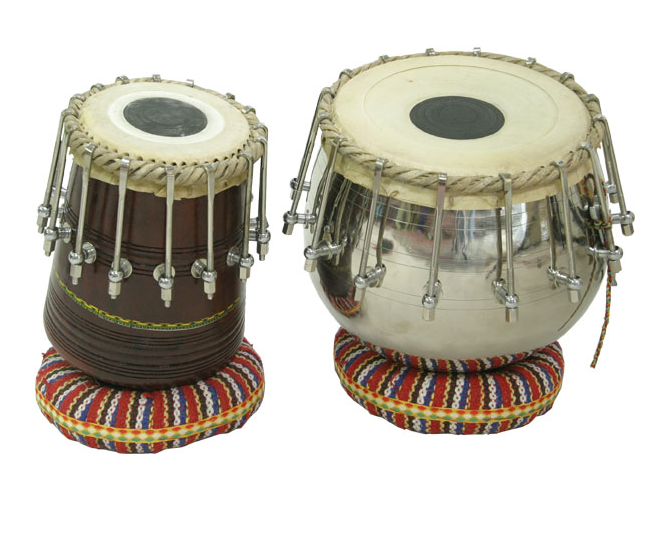
The centerpiece of the concert was to be a concerto for violin and tabla by Shirish Korde, a composer local to Boston. The sound of the Indian drum combined with the violin captured the interest of many students, particularly because it was “different than what they usually have” and because of “how fast he was going!”

The orchestra also performed Ginastera’s Variaciones Concertantes & Musorgsky’s Pictures at an Exhibition. From our seats in the balcony, we were able to notice elements about the concert that those on the ground floor couldn’t see. Students pointed out the giant tuba mute and the “sound effects” coming out of the percussion section, from ratchets to cymbals to the giant chime. These were particularly appreciated as one student put it because, “this time, I didn’t fall asleep ‘cause the music kept waking me up!”

Pictures at an Exhibition is a piece of many contrasting movements, and a student on the bus ride home commented not only on the range of feelings in the music, but told me, “it was alive, like a human being.”

Despite some trepidation about losing our bus driver to the black hole that is pre-Red Sox game downtown Boston, Arlyn was able to sprint, flag our driver down, and guide her back to Sanders Theatre. With some post-concert snacks in our bellies, we rolled up at 1392 Westminster Street right on time.

-Rachel Panitch, Fellow (07-09)

Students

Teachers

Classes

Performances, Events, Projects