Blog

Daily Orchestra Program Update: End of Year!

13959884640_b0dd4ddcbd_b

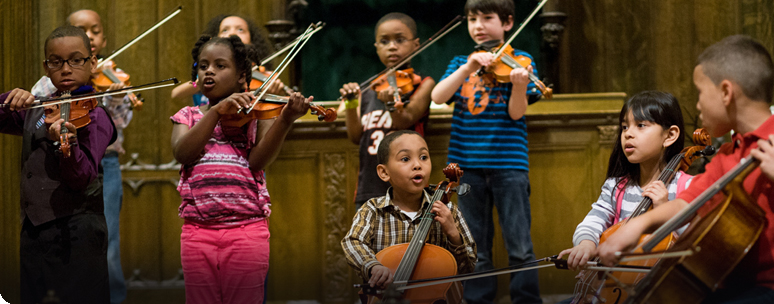
Things have been busy at the Daily Orchestra Program! From learning the story of Johann Sebastian Bach’s life (in three action-packed installments, complete with cliffhangers) to performing two concerts, our students have had no shortage of things to do and music to learn! As usual they have been embracing it all with enthusiasm, and as we draw closer and closer to the end of the school year the fruits of their hard work are starting to show themselves in exciting ways.

We spent much of this semester preparing a full program of music, including four short pieces. The first-year Britten Orchestra worked hard to improve their bow holds and instrument posture and showed off their ease of playing their open strings with the boot-tapping favorite “Tuning Hoe Down.” Meanwhile, the second-year Beethoven Orchestra learned some new, more advanced left-hand finger patterns in order to play a pizzicato bass line for the D-jam Blues (our rendition of Duke Ellington’s C-jam Blues). This meant that the Beethovens actually filled in the role Adrienne Taylor played for them last year, while the Brittens took over for the Beethovens. We also added to the program a cute song referencing the Grimm’s Fairy Tale “The Elves and the Shoemaker,” and last but not least the classic theme from the William Tell Overture by Rossini.

We were lucky enough to have two opportunities to perform our repertoire. On the last day before spring break we turned our room at Federal Hill House into an auditorium and presented to families and staff members a full half-hour of music, complete with solo performances! There were feelings of pride and happiness emanating from all corners of the room, and we sent everyone off for spring break feeling victorious!

14143719512_577747fa5c_b

14146557055_afbffb7bf5_b

After spring break we returned to perform the same program again (just like a professional orchestra might do!) at a special event for the Olneyville Housing Corporation. Our students were calm and poised in the face of flashing cameras and chatting event-goers, and their families, anxious not to miss a single moment of the performance, crowded the stage and filled the air with support and cheers after each number.

Now we are in the final stretch to the end of the year, and we are working on some exciting projects. We’re also learning about the life of Ludwig van Beethoven, while we learn to sing and play his famous melody Ode to Joy.

— Lisa Barksdale

In Memoriam: Maxine Greene

DSC_5316

Maxine Greene has died. My interactions with her set me on the course I am on, and the career I have had.

In 1995 I heard Maxine speak at the Coalition of Essential Schools Fall Forum, and her fresh approach to articulating the intersection of arts, education, and social change provided a huge opening in my thinking. Releasing the Imagination was published that year, and it became a bible for me in my academic work, and in forming ideas for what became Community MusicWorks.

Maxine was an embodiment of the living philosopher—her ideas weren’t static, but lived, examined, reviewed, discussed. And, unlike some brilliant thinkers, Maxine was truly present and human—not lost in ideas only. It was the latter quality, the familiar Jewish Brooklynite that led me to introduce her to my grandmother over dinner at “Busby’s” in Maxine’s neighborhood—two women, born in the ‘teens, who embodied the culture from which they came, but also transcended the times. Both boldly moved through gender barriers and became women leaders—in Maxine’s case by breaking into the world of professional academic philosophers, and in Grandma’s case by moving to Manhattan and living the last chapter of her life as a city girl, working, going to school, taking in the cultural life and more. (For years afterward, Maxine would try to remember how we had first met…”was it your grandmother who introduced us?” she would ask.)

What an honor when Maxine accepted my invitation to come to Providence to speak at a conference we held here, whose purpose was to further build the community of artists and educators who were applying her ideas, albeit with baby steps by that point, in 2000. Then again, in 2008, when I could proudly tell Maxine that we had built the “community of educators committed to emancipatory pedagogy, particularly in the domain of the arts.” (from “Texts and Margins,” in Releasing the Imagination.)


6a00d83455287c69e200e54f7439118833-800wi

And then there was Maxine’s living room, the venue for so many magical discussions, visits, and salons, including one in which our quartet performed. Maxine would describe for years after, the transformation she felt, looking at the trees in the park across Fifth Avenue from apartment 3C, as they had never appeared before—how the music transformed even her view of daily life. How many people, devotees, students, august leaders, sat in that living room?

I remember talking with Maxine on many occasions about Paolo Freire, whose work is another bedrock inspiration for CMW and countless other educational initiatives. “Yes, I loved Paolo. I remember the birthday party I threw for him…” For Maxine it was like that. Friendship, love, humility—never aware of her own stature as among the pantheon of gods who inspire us.

It’s always an unfinished conversation. She taught us that. It’s a community in the making, a process of always becoming, never arriving. It’s never static, and we should fear someone who says it is.

It’s that quality that makes her death devastating. Of course, at 96, we can say it was a full life, well lived. But, I have never felt finished as her student. The world is emptier without being able to stop by and ask what she thinks of the latest news, the newest angle on the problems of education, of arts, of encouraging young people to imagine.

Thank you, Maxine, for a lifetime of inspiration. We’ll carry on for you, and in that honor you, with great love.

– Sebastian Ruth


Read the transcript of Maxine Greene's 2008 talk at the Imagining Art + Social Change conference here.

Watch the video of Sebastian's interview of Maxine Greene for the 2011 Music & Civil Society symposium here.

Rally for Peace in the West End

2photo

Yesterday afternoon, several CMW students who are also students at TAPA (Trinity Academy for the Performing Arts) helped organize and participated in a neighborhood rally for peace, held at the Armory. They also performed on bucket band, alongside the Extraordinary Rendition Band and other community members.

CMW Symphony in Rehearsal

Photo

The CMW Symphony was in fine form last night, rehearsing the CMW Round/Michael Nyman mash up for the year end Gala performance on May 27 at the Roger Williams Casino. We had all the parts together for the first time last night, and our fearless leader, Chase, worked with us on hearing all the parts together, making a more gritty sound together, and cutting off together.

(Theme of the rehearsal: TOGETHER!)

Join us!

Year End Gala Student Performance

Tuesday, May 27 at 6 pm

Roger Williams Park Casino, Providence

CMW receives MAP Fund Award

Community MusicWorks has received funding from a nationally competitive performance fund, the MAP Fund, a program of Creative Capital primarily supported by the Doris Duke Charitable Foundation, with additional support by the Andrew W. Mellon Foundation. The project, one of 39 chosen from over 900 submissions, will support a production in the late fall or winter.

Community MusicWorks is commissioning composer Ken Ueno to create a site-specific work for the Community MusicWorks Players at the RISD Museum in Providence to coincide with the re-dedication of the ten-foot Dainichi Buddha housed there. Encompassing three live performances by Ueno and Community MusicWorks Players and a month-long sound installation in the museum, the project will engage diverse urban communities in contemporary music and ancient Asian art.

Entitled Four Contemplations, the work takes as its subject the RISD Museum's ancient Dainichi Buddha, and is intended for listeners to gain a new and personal relationship to concert music through their experience with the Buddha and Ueno’s ethereal music. Ueno's compositional approach frequently involves extra-musical modeling, including using images, cultural phenomena, or architecture as the basis for structural decisions, somewhat analogous to the use of architectural proportions in Renaissance music. For this project, Ueno will draw upon the foundations of mindfulness in Buddhist theology. The evening-length work for 12 CMW musicians will unfold in multiple movements – solos, duos, trios, and quartets – some accompanied by throat singer (Ueno).

Read more about the MAP Fund grant here.

This Sunday: The Fred Kelley Scholarship Concert

IMG_5572

Dear Friends,

We invite you to celebrate the memory of a great friend and to support the Fred Kelley Scholarship Fund. Join us this Sunday, May 2 at 2 pm at the RISD Museum Grand Gallery for a performance by the Donegal String Quartet, featuring CMW Players EmmaLee Holmes-Hicks, Ealaín McMullin, Jesse Holstein and special guest Heath Marlow.

Fred Kelley, a CMW supporter who loved chamber music, passed away after a brief illness in 2007. Fred’s son, Mike, is a member of the ensemble in residence for the Apple Hill Center for Chamber Music in Nelson, New Hampshire. Apple Hill’s central mission is to bring people of diverse backgrounds and cultures together to study and perform chamber music together through their Playing for Peace program. It seemed a fitting tribute to form the Fred Kelley Scholarship Fund to honor his memory.

The Community MusicWorks Fred Kelley Scholarship helps to send CMW students to Apple Hill to study chamber music with friends from all over the world. Last year, the Fund was able to send six students to Apple Hill in August.

This year, we have the largest number of applicants to date. With tuition running at $1,700 per student to attend the ten-day chamber music workshop, the Scholarship Fund needs your support. 100% of your tax-exempt donation will go to sending a CMW student to Apple Hill this summer. No donation is too small (or too big!).

We hope to see you there!

Jesse, EmmaLee, Heath and Ealaín

The Annual Fred Kelley Scholarship Concert

featuring The Donegal String Quartet

performing the works of Haydn, Beethoven, and Cole Porter

EmmaLee Holmes-Hicks and Ealaín McMullin, violins

Jesse Holstein, viola

Heath Marlow, cello

Sunday, May 4 at 2:00 pm

RISD Museum Grand Gallery

224 Benefit St, Providence, RI

Sunday offers free admission to the museum

and free street parking.

Phase II Youth Salon: Reflections on Connection in a High Speed World

Malachy Youth Salon Poster

As many of you may already be aware this year's Youth Salon is fast approaching. For Phase II that means it's crunch time and we'll all be brainstorming as much as possible to bring a thought-provoking experience to our audience. For everyone else that means the chance to participate in a night of music and discussion that should be a glimpse into the process of idea generating and dinner time camaraderie that is a staple of Phase II. This year we are hoping to bring as immersive an experience as possible. Our audience will be as much a part of presenting our thoughts on the theme as we will be. At least that's the idea.

Speaking of the theme, this year's youth salon title is Reflections on Connections in a High Speed World. If our discussions have been any indication, this promises to be a topic approachable from many different directions. We've been focusing our recent work on developing questions and discussion guiding techniques that should yield the most juicy conversation. With a diverse audience, many of whom, unlike ourselves, grew up before the age of the internet there will be a much broader range of opinions. The idea of digital communication is a fascinating new dimension of modern life that carries with it a great spectrum of ideas. If you enjoy music, discussion, spoken word poetry, avant-garde theater or good food this will be the event for you.

-Liam, Phase II

Phase II Selfie

Phase II Youth Salon:

An Evening of Dinner, Discussion and Music

Reflections on Connection in a High Speed World

Friday, May 2 at 7 pm

Bell Street Chapel


Daily Orchestra Program: Meet James

Photo 4
A few Fridays ago I sat down for a short interview with one of the violinists of the Daily Orchestra Program. James is nine years old, in the third grade, and attending Young & Woods Elementary School. He is a friendly, active, energetic young man, and I’m so thrilled that our blog readers will have this small chance to get to know him a little bit better. I hope you enjoy meeting James here. We hope to see you soon in person at our next concert!

~Lisa Barksdale

LB: So, James, you were one of our very first students in the Daily Orchestra Program, and now you’re in our second-year “Beethoven Orchestra.” What do you like about being in orchestra?

JJ: I choose to play music because it’s fun and other people are playing. It’s not like you’re the only person that plays the violin. It’s an orchestra. It’s fun meeting other people who play nice instruments that we don’t really see. (I believe he’s talking about some of our guest artists who have brought unusual or unfamiliar instruments to share with the group). It’s nice seeing people who play the violin for a lot of people, and it’s nice because other people are in the program. And because other people help me and help me. . . and sometimes I can be a little naughty and stuff (here James has a somewhat bashful look), BUT they still help me and make sure I do the songs, and if I need help on the songs they can help me.

LB: That’s so good to hear!

JJ: It’s very expire. . .expiretive?. . .expired? Wait, no not expired. . .

LB: Inspired?

JJ: Inspired! – for me because it’s fun playing all types of different music. Even though we have to work on the new music, when everyone in the orchestra and I play with other people it feels fun, and knowing that I can play all types of places when I get bigger and I can play for a lot of people – for the president! – and all kinds of places!

LB: Wow. James, I think you’ve actually answered a lot of my questions in one big sentence. Thank you! Now I want to ask what is your favorite piece of music that we’re working on right now?

JJ: Does it just have to be one?

LB: Doesn’t have to just be one I guess! I kinda want to know your most favorite.

JJ: It would probably be “The Blues” and then the second one “Goblin Cobbler.”

LB: Ah! Cool.

JJ: And I’m still learning how to play “William Tell.”

LB: And what do you like most about the violin?

JJ: I like. . . hmm. . . the sound of it. And when I play with my violin and when other people have their violin it sounds like one big violin orchestra.

LB: Okay, and this next one might be a hard question – What is your least favorite thing about the violin?

JJ: Huh. . . uh. . .putting on the sponge!

LB: Ha! Ya know, I don’t really like that part either! Wouldn’t it be easier if we didn’t have to do that sort of thing? Okay, so today is Friday. What does a usual Friday look like for you?

JJ: We make up stuff. On Fridays the whole orchestra with the “Brittens” (nickname for our first-year orchestra) come together and we can make up anything. On Mondays everyone has to be in the violin section, viola section, or cello section, but on Fridays everybody is next to other people who play violin, cello, or viola, and then when you play something and we repeat what you play it sounds very different because you’re not next to someone who plays the same instrument.

(On Fridays we branch out from our regular orchestra formation and instead form a large circle for improvisation games. We try to mix it up so that people can stand or sit next to people/instruments they normally wouldn’t sit next to.)

LB: Hmmmm. I like that about Fridays too. I think people might be interested to know what other kinds of things you like to do in your spare time?

JJ: In my spare time I probably would play Blues and then if I’m in the mood I probably would play William Tell.

LB: In your spare time you’d like to practice the violin??

JJ: Yeah.

LB: Wow! I wish all my students were like you! But what about if you can’t practice your violin or you’re not in music. What do you like to be doing?

JJ: Sports. Playing outside with my friends. I have a game but I don’t really like sitting down games. I like to get active and get outside and play!

LB: I like that too! I also hear that you’re quite a basketball fan.

JJ: Yes.

LB: I’m not a basketball player, but I have a question I’ve always wanted to ask – I’ve always wondered how the basketball players are able to get the ball in the basket no matter where they are on the court? I’ve never been able to do that. How do you think they learn how to do that?

JJ: A lot of practice! And. . . when I get bigger and I’m in college I want to play the violin and basketball!

LB: Okay! And our very last question – if you could describe yourself using one word what word would that be?

JJ: Happy!

Students

Teachers

Classes

Performances, Events, Projects