Blog

Jonathan Biss: An Artist of the World

CC Jonathan_Biss_328_credit_Benjamin_Ealovega-1

Pianist Jonathan Biss performs a benefit concert for Community MusicWorks on Friday, April 18 at 8 pm at the RISD Museum Metcalf Auditorium. Tickets for this event are available online here.

Guest writer Jill Pearlman recently spoke to Jonathan about the event and his connection to CMW:

It’s not enough to be only a concert pianist these days, says concert pianist Jonathan Biss. It is not enough to be hailed as one of the best of your generation, as he is. It’s narrow stuff, having your tails dusted off before stepping onto stage at Carnegie Hall. It’s a new world, and Biss, who will be performing for CMW on April 18, has his sleeves rolled up, ready for it.

“The concert performer as a cloistered phenomenon is rapidly becoming extinct and that’s a good thing,” Biss says with characteristic brio. 

Biss’ perspective is remarkably wide and all-encompassing. For him, an artist of the world means not only traveling internationally but being online, working in communities, plunging into new zones for the love of his art. If his goal is to communicate with the utmost of passion, he needs a passionate audience to relate to. And that’s his mission.

Biss is 33. One feels that his prodigy and personality found itself when he was young, and while it has deepened, has not really changed. He is brilliant and hyper-articulate, warm and driven to share the expanse of his world. 

One of Biss’ current obsessions is Beethoven – he has embarked on a path of recording the composer’s 32 piano sonatas, one CD a year over nine years. Biss’ appetite for a new, freer role for the musician/composer has a model in the master. In an online course that Biss teaches, he speaks of Beethoven’s breaking loose from the old role of court composer and musical servant, and living by his wits as a freelancer without steady support. The freedom was bracing, and led to legendary and radical creativity.

The classical world is in hard times now. Audiences are getting smaller and smaller. The music runs after larger audiences by offering crowdpleasers that aren’t terribly challenging. Crisis has brought urgency, and as deep and rapid as it is, it has the possibility for radical change.

“The old models aren’t working as they did before,” Jonathan says. “We are all ripe for a conversation. I’m not rejoicing in anyone’s struggle but I do think it’s good to be forced to question ourselves. What’s working, what’s not. To be forced to evaluate everything.

“We are being asked to be ambassadors for our art. Have a different role in culture and society. Asked to think about the role of music on the people who are listening. People with passionate interests can find one another. You find your way to your audience. To what you can communicate with passion.”

Biss has Rodin-like hands, long creating fingers that have a romantic warmth. Online, on the free Coursera class via Curtis School of Music he plays and speaks to people who “suspect they could love classical music but don’t understand the language. Unless you speak it, you don’t love it.” In the course, he exposes people to a performer’s relationship to the music with all its layers and complexities, allowing us to hear music in a way that we hadn’t previously.

Community MusicWorks is close to Biss’s heart, for the way it engages people from the ground up, art as life and life as art. Biss met former CMW Managing Director Heath Marlow when he was 14 at summer camp. “I instantly thought CMW was a fantastic idea,” he says. “I was attracted to the idea of thinking about the role of the musician in the community. The model that they’ve established is so right-headed and inspired. The best thing I could hope for would be if it were replicated in every community across the U.S.” 

“CMW musicians play on such a high caliber. They have impact on the communities which they’ve chosen. What they do is different than outreach, a word I hate. They have chosen a life’s work through music.”

To celebrate that, Biss plays a benefit concert for CMW following the release of each year’s Beethoven CD. Scheduling prevented him from appearing last year, so momentum is now building for the April 18 concert when Biss will salute CMW and the release of Beethoven Sonatas, Vol. 3. He will play two sonatas as well as selections from Janacek and Chopin.

Of Sonata Opus 10, no. 2, Biss says, “It doesn’t get played for some reason as often as it should.  It is distinguished by fantastic wit, almost Haydnesque.  It is marked by the relish to surprise, a sense of wit and sense of play.” The other will be the famous Waldstein sonata, which he performs on the latest CD. “The Waldstein is so ubiquitous it was hard for me to hear it with open ears. But I have rediscovered it. It is an extraordinary masterpiece. There is so much mystery and wonder. Of looking out at infinity, stumbling towards an infinity in space. It is heroic as fits the middle period, but it has a searching quality.

“The sonatas are monumental and mysterious enough to be able to accommodate infinite points of view,” says Biss. “They are, indeed, endlessly interesting. The player never comes to a point where you think, now I know it.  They always reveal some other aspect.” He pauses in wonder, then laughs. “By the time I finish the ninth CD, it will probably be time to start over again.”

-Jill Pearlman

Providence-based writer Jill Pearlman worked in music journalism in New York for over a decade. She’s currently tapping some of her experiences for her novel, Clio’s Mobile Home.

Photo of Jonathan Biss by Benjamin Ealovega.
Bow Master at All Play Day

On Tuesday March 11, Bow Master Jesse offered all CMW violins and violas a bow class during the studio class portion of All Play Day!

Photo

Students worked in partners on their "Bow-lympics" exercises, practicing their spider crawls, crunchtastic voyage (making a good heavy crunchy sound near the bridge), and pinky push-ups and Captain Hook (first finger) pushups.

Photo-2

One of the most challenging exercises was learning how to shift the weight of the hand towards the first finger (at the tip) and then towards the pinky (at the frog). This keeps the bow hand relaxed, and helps develop smooth bow changes. Which would make anyone smile!

Photo-3

Thanks to Jesse for sharing his wisdom and offering a fun and helpful class!


Bach to the Future II

8252185791_6c0c3697bb_b

Don't miss this year's J.S. Bach marathon!

The Bachfest is an all-night-no-intermission celebration of community and music presented by Community MusicWorks. The event features more than 50 performers, including the CMW Players, Phase II students, and local experimental musicians, who will keep the music going throughout the evening. The marathon is a mix of traditional and experimental performances and interpretations of the music of Johann Sebastian Bach and will be held once again in the magical space of Brown University’s Manning Chapel.

View photos of last year's marathon here.

You are encouraged to bring your pillow & blanket.
Get comfortable and enjoy the music of Bach!

Sakiko Mori

Curator, Bach To The Future

  8253231126_9cede56247_b

8252139345_d149bb11b3_b

8253224342_d0ab63e730_b

8252166739_4614c57f12_b

8253245042_3968f213bb_b

8253260092_a0f8807182_b

Friday, April 4 – Saturday April 5
Bach Marathon

The overnight Bach Marathon returns!
7 pm to 7 am Bach performances.

Manning Chapel, Brown University, Providence

Teaching Moments

One of the great (and sometimes terrifying and intense) things about the Daily Orchestra Program is that we see and work with the same students every day of the week! This means that student transformations can sometimes happen over a surprisingly short period of time. Often I am so engrossed in each moment that I forget to see this big picture. Just like when I’m at home staring into the mirror and seeing all my flaws, in my teaching I am easily caught up in the details I want to improve – the lessons that don’t go according to plan, the student who still has trouble keeping his viola’s scroll up, the orchestra’s responsiveness to instructions, and of course my own teaching’s effectiveness and flow.

Every now and then moments occur that do make me step back and remember the whole. Some of those moments are the obvious ones, like the performance party back in January, but more often than not they are private, witnessed by only a few (well, maybe thirty max).

Today I had one of those moments when I was faced with the task of calming a student down who had become so angry he had run away right before orchestra and disappeared for several minutes. When he resurfaced (as if by magic after my frantic and unsuccessful search) he seemed on the verge of breaking something. I learned later that another student had kicked him by accident. I listened to his story and said I could understand why he was feeling angry. But then I asked him calmly whether in that moment it was more important to sit there and feel angry or whether participating in music was more important. He answered softly and immediately: “music.” Something changed. He became a calmer, more collected and purposeful student than the one who ran away from me only moments ago. By realizing he wanted to play music that day he was able to if not forget his anger, at least put it aside for the duration of orchestra.

One of the most difficult tasks we face as human beings is having to deal with our emotions. I notice children struggle with this, especially when those feelings are scary, like sadness or anger (heck, I still struggle with those!). Adrienne and I both share the vision that in our Daily Orchestra Program we are not just teaching students to play string instruments, we are teaching them to be kind, compassionate, healthy, and happy human beings. Helping our students to handle their emotions is part of that vision, and even though my moment alone with an angry young boy didn’t involve teaching him to play music (there wasn’t even an instrument in the room), it somehow felt like a small success.

Whether in the future he’ll be able to draw anything from that one moment in time I don’t know. My hope is that he will, but if he doesn’t. . . well, we’ll be seeing him again tomorrow. Each day presents opportunities to guide our students through that harrowing and beautiful landscape of human emotion. Luckily for us, all of music could be seen as humanity’s way of dealing with its feelings, so we’ve chosen our vehicle well.

-Lisa Barksdale, Associate Resident Musician, the Daily Orchestra Program

Nyman’s Quartet No. 5

Resident musician Chase Spruill writes about the North American premiere of the Michael Nyman's Quartet No. 5:

In the early 1980s, Michael Nyman attended a performance by Arditti Quartet whose program housed a performance of the mighty Opus 133 Grand Fugue by Ludwig van Beethoven. Their performance and interpretation of the music left quite an impression on the composer who would later go on to remark that it was the most theatrical performance of the Fugue he’d ever seen or heard, leaving him with the impression that Beethoven was attempting to burst out of the music and compositionally transcend the confines and limitations of the sound world for a string quartet in order to create something orchestral. When Arditti Quartet commissioned Michael Nyman to write his first string quartet in 1985, it was their performance of Beethoven which helped inspire his idea to “exorcise the impressive and oppressive history of the string quartet” through a series of quotations by composers like John Bull, Arnold Schoenberg and Alex North. The end result was a pulse-pounding, relentless, hyper-rhythmic, uplifting and continuous world of sound that never allowed a listener’s ear to wander. Nyman wrote three more string quartets between 1988 and 1994 which touched on and explored inspirations from Scottish Folk Music to traditional South Indian rhythmic cycles. The 20 years after that were devoted to the continuous writing of film scores for acclaimed movies like Jane Campion’s The Piano and large-scale concert works for the Michael Nyman Band and world-class orchestras like the Royal Liverpool Philharmonic, but with no sign of whether he’d ever write for the combination of a string quartet ever again.
 
I had the fortune to begin a long-distance correspondence with the composer a couple of years back while premiering his newest chamber music arranged for the combination of piano, flute, clarinet, violin and cello. The plan was to premiere and to record these works over a period of a few years, and ultimately, to release these recordings the year of his 70th birthday, which would be part of a larger celebration of his career thus far. This plan led to a quiet dinner meeting I had with his manager who happened to be in New York City on business, and during this dinner, I got the answer I’d been hoping to hear:  “He’s got this intense notion of writing ten symphonies in one year and releasing recordings of them with The World Orchestra. Also, there’s a new string quartet!”  The piece was to be premiered in the UK by the Smith Quartet—champions of contemporary string quartet literature—but without being able to hear a recording of the new work, I asked her if she would kindly describe the piece for me. She went on to say it was a wild, six-movement exploration of song and dance which included ballads, tangos, and dances that would be dangerous to dance to.  I only had one question for her at that point:  When was the U.S. Premiere so I could hear this piece?  My entire drive back to Providence, I kept replaying her answer to my question in my head, which was something like,” “Oh, we haven’t planned a U.S. premiere of this piece yet. Do you have any friends that you think would like to play it?”  I was new to Community MusicWorks at the time, but as it happened, yeah, I had a couple of people I thought might be interested. Sebastian had been talking about the next season here at CMW and the possibility of a quartet program in 2014. He was enthusiastic about the idea of premiering a new work by Michael Nyman knowing it was the first string quartet to be written by the composer in almost 20 years.  It seemed like the kind of news that should go along with fireworks and balloons. When he asked if I’d like to be part of that program, I think it’s quite possibly the fastest I’ve ever said yes to anything.  He asked what the piece was like and I told him what I knew. One year later, we’re a few weeks away from the North American Premiere.

-Chase Spruill

Join us for the weekend-long celebration of Nyman's Quartet No. 5:

Friday, March 21 at 5 pm
Salon at the Athenaeum: Nyman & New Music with the CMW Players
Providence Athenaeum, 251 Benefit Street, Providence
 
Saturday, March 22 at 4 pm
Community MusicWorks Players
Westminster Unitarian Church, 119 Kenyon Ave, East Greenwich
Suggested donation: $10
 
Sunday, March 23 at 4 pm
Community MusicWorks Players
*Please note change in location*
First Unitarian Church of Providence, 1 Benevolent Street
Suggested donation : $15


This Sunday: Ars Subtilior No. 2

Lucierroad

Our resident cellist Laura Cetilia curates the Ars Subtilior series and gives us a preview of this Sunday's concert:

The second edition of Ars Subtilior this Sunday, March 9 at 4:30 pm at Machines with Magnets in Pawtucket will feature works for piano and cello by composer Alvin Lucier. I am extremely excited to be presenting this program, as I consider Lucier truly one of today's greatest living composers. My initial intention of starting the Ars Subtilior series was due in part to the influence of Lucier's ideas on my own musical life and aesthetic.

Much of Lucier's work is influenced by science and explores the physical properties of sound itself: resonance of spaces, phase interference between closely tuned pitches, and the transmission of sound through physical media. What results from such deep exploration of sound is something that I find completely mesmerizing and beautiful. Listeners sometimes forget that sound is having a physical effect on them, especially sounds other than those that are loud or abrasive. What happens in Lucier's music is so subtle it can easily be lost if one doesn't know what to listen for.

On Sunday's concert Sakiko Mori, myself, and the adventurous and generous engineers and producers from the Machines with Magnets recording studio will be presenting three of his works. In Music For Piano With Slow Sweep Pure Wave Oscillators, two pure electronic soundwaves start on the same note, and then diverge and converge over 16 minutes. Meanwhile, sparse droplets of piano notes follow their movement, but never quite hitting the same pitch, leaving ripples of disturbance in the pure waves' wake. This gentle "beating" also occurs in Twonings for cello and piano, but on a much subtler scale. The cello plays only (high and difficult to reach) harmonics throughout. The pianist attempts to play in unison with the cello, but due to the different tuning systems of the instruments (equal temperament of the piano, compared with just intonation of the cello), slight audible beating occurs. 

Finally, in Music for Cello and One or More Amplified Vases, you will hear the sounds of the cello magically resonate through a variety of amplified glass vessels. Each one of these vases have been hand-made specifically for this event by RISD Glass faculty member Jocelyne Price. You can see samples of the vases that will be used at the concert below.

I invite you to experience this stunning and unusual music in person on Sunday, and don't forget to change your clocks before heading over.

DSC_0111

Ars Subtilior No. 2

a concert series on subtlety in experimental music

featuring Sakiko Mori, piano and Laura Cetilia, cello


Sunday, March 9 at 4:30 pm

at Machines with Magnets

400 Main Street, Pawtucket

$5-15 suggested donation

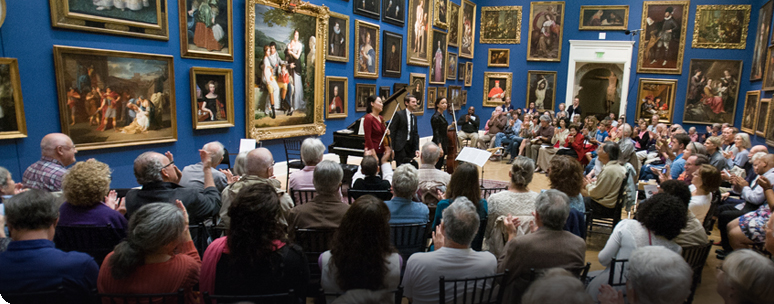
Tonight: Sonata Series at RISD Museum

“You picked two pieces that rely heavily on color!” remarked Lucia Lin (violinist of the Muir Quartet and my former teacher). She had generously spent her Sunday morning listening to Jeff Louie and me play Sergei Prokofiev’s “Five Melodies” and César Franck’s Sonata and offering us her feedback. One of the things I love about Luci’s teaching is that she asks questions that get my mind churning. My brain tends to exhaust itself worrying about technical details—this tempo still too fast for my fingers, these notes still out of tune, this spot not loud enough, etc.—but Luci will ask me a question that forces me to step back and see the big picture. She’ll help me remember why I was drawn to a piece of music in the first place, and what kind of story I want the piece to tell.

“What do you like about Prokofiev?” was Sunday’s first question.

“Well, that’s easy!” I thought to myself at first. Prokofiev has always been one of my favorite composers. When I was a kid I would listen to the music from his ballet Romeo & Juliet over and over and sing the themes while producing small dramas with my Barbie dolls.

Putting my lifelong love for Prokofiev into words, however, wasn’t particularly easy. When I think of Prokofiev’s music, I think of drama, dance, evocative harmonies, vocal melodies, and color. Jeff was able to articulate his thoughts a little better than I, pointing out the “rich harmonic language, which even when it’s very dissonant is still lyrical.” We realized that even though Five Melodies is a short work (about 13 minutes), it contains a striking range of moods, characters, and landscapes, and its dimensions expand from intimate duet to quasi-orchestral at times. In a way, the piece is the perfect little capsule of all the things we love about Prokofiev.

Though I’m less familiar with other examples of César Franck’s work, his Sonata for violin and piano evokes many of the same things for me as Prokofiev. This magnificent work, my personal favorite of the Sonata repertoire, is filled with singing melodies, lush harmonies, drama, and of course color. The piece often takes on the quality of a fantasy rather than a formal sonata, as various thematic material recurs throughout the different movements. These melodies could be seen as motifs for a story. Whatever the story is, it’s full of fire, passion, introspection, and love. Just as Prokofiev’s Melodies, it carries us through a full spectrum of textures, colors, and feelings.

So if you need a break from all the dreary gray and white outside, we hope you can come bask in the colors of Prokofiev and Franck this evening at the RISD Museum!

-Lisa Barksdale

Sonata Series Event 
RISD Museum Grand Gallery
Thursday, February 6
7pm
Free with Museum admission


Daily Orchestra Program Update

Diego & James

It’s Tuesday evening, about 7:00 PM at Federal Hill House. Lessons have been taught; two orchestras, totaling about 30 second-graders, have rehearsed; instruments have been hauled to and from rooms; and tables and chairs have been stacked and unstacked, arranged and rearranged.

I’m giving Adrienne the rundown of today’s session with our first-year Daily Orchestra Program students (whom we have now dubbed “The Britten Orchestra”). “The problem is I just can’t get the cellos to stop talking!” I say.

We both simultaneously realize that it’s because they’re all friends, and they just can’t help joking around with each other during orchestra. (Somehow this problem isn’t present in the violin section, but I’ll keep my own musings about the larger implications of the nature of violinists vs. cellists to myself.)

Even though the endless chatter from our young second-grade cello section is giving me a headache I decide that it’s really not the worst problem to have, and it might even be a sign that we’re doing something good. After all, having our students make friends with each other is one of our goals. So if they’re making friends and making noise together? Success! Sometimes I just wish they’d make noise more quietly.

Photo(18)

Up until the winter break our two orchestras were meeting as two separate groups at separate times. By our final class of 2013, our second-year group (now dubbed “The Beethovens”) had made steady progress on the familiar round “Frere Jacques” as well as the seasonal favorite “Jingle Bells.” On Fridays the Beethovens continued to have fun with improvisation games. One of the favorites was “Animal Guessing Game,” for which students divided into teams, came up with an animal and a way of imitating that animal on their instruments, and had other teams guess their animal based on a short performance. Our “Holiday Guessing Game” was the most creative experience yet, though sadly, no one was able to guess the exact words “Santa climbing down the chimney with his reindeer on the roof” (We guessed santa and reindeer, but not the entire specific scenario).

Photo(19)

Our first-year ensemble (the “Brittens”) ended 2013 with a spectacular review game show, in which each student added a small piece to a winter scene when he/she answered a question correctly. The winter scene ended up looking like this: 

Winterscene

Okay, so it didn’t quite turn out in the way I had envisioned when I originally cut out the pieces, but that’s just the way things go around here. The conglomeration pictured above is proof that each and every student was able to answer a review question correctly, which means that each and every student learned something in the first half of their year in the Daily Orchestra Program!

Since the downbeat of 2014 we have taken the courageous step of combining two orchestras into one. The Brittens and Beethovens have come together, each group adding to the other group a dimension that might not have been present before. Last Friday our freshly combined orchestras strutted their stuff for the audience at the Performance Party. The Beethovens supplied a pizziccato accompaniment for the Brittens during the truly rockin’ “Rock N’ Roll.” Then they proceeded to stun me with their beautiful singing of “Are You Sleeping,” before they played it on their instruments, with Beethovens bowing the melody along with a steady pizziccato provided by the Brittens.

Adrienne and I were both so proud of our Daily Orchestra’s performance. With the week shortened by a holiday and a snow day, we were not quite sure we’d be able to pull it all together. However, our young orchestra members united for the evening and not only did an amazing job but smiled and clearly enjoyed themselves while doing it. “You couldn’t have wiped the smile off of Jimmyla’s face!” beamed a joyful grandmother.

I saw many many unwipeable smiles that night. It is such a pleasure to see our students taking pride and enjoyment in their music. Adrienne and I are both looking forward to the new semester ahead with the Daily Orchestra Program!

-Lisa Barksdale

Students

Teachers

Classes

Performances, Events, Projects