Blog

Daily orchestra program update

After two transformational years as a Fellow at CMW, I moved to Boston in 2010 to participate in the Sistema Fellows Program at the New England Conservatory. During that inspiring year, I learned about the many aspects of how to create and manage an El Sistema-inspired program in the US. In the spring of 2011, I spent five weeks in Venezuela traveling to different parts of the country, observing and teaching in the music programs there. I returned to the U.S. inspired to share the experience of El Sistema with families in Providence.

Thanks to support from the Andrew W. Mellon Foundation, I was able to return to CMW last season to spend time preparing to launch the new program that I had been dreaming about creating. I had the opportunity to put into practice some specific ideas for music education that I gathered in Venezuela with a class of CMW beginners. I also enjoyed my work with CMW's Green Magic Orchestra and Phase II.

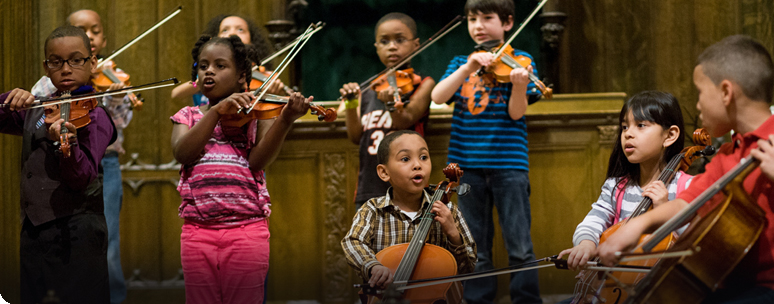
On September 10, CMW will launch a daily string orchestra program inspired by El Sistema. We are excited to be working with our partner in the neighborhood, the John Hope Settlement House. In combination with JHSH's Out of School Time Program, students in the orchestra will be provided with private lessons, snacks, homework help, mentors from Brown University, arts and crafts activities, and, of course, daily orchestra rehearsals. We’ll be starting out with a group of 25 first graders, including children from CMW's waiting list, children from JHSH, and children who we are recruiting to join the program.

Jhsh

Last week, violinist Lisa Barksdale and I had a chance to meet some of the families who will be entering the program at an information session hosted by JHSH. At the session, I shared with families this short video of people talking about El Sistema. The video features music performed by youth orchestras in Venezuela.

Do you know someone who is the parent of an eligible first grader? We are looking specifically for children who have the most to gain from this special opportunity to participate in a free daily after-school program. Please invite them to contact me via the CMW office.

-Adrienne Taylor, Program Director

ArtPlace blog posts

Artplace blog

As part of CMW's ArtPlace award, monthly updates will be posted on ArtPlace's website.

ARTPLACE: What is your elevator pitch when you describe your project to people?

RUTH: For fifteen years, Community MusicWorks’ resident musicians
have been creating a musical community with students and families in the
inner-city neighborhoods where we live, teach and perform. We have
noticed that community is one ot the significant outcomes in our
work–among students, between professional musicians and families, and
significantly between members of our audiences. Gather is a project that
intends to amplify the ways in which residents of a city grow to have a
deeper experience of community through their relationships with one
another. We aim to turn concert audiences into micro-communities, and
find out what happens if the person in the seat next to you is as much a
part of the concert experience as the musicians on the stage.

Read brief interviews with CMW founder Sebastian Ruth from July and August.

Welcome Chase!

Earlier in the month, we were thrilled to welcome Chase Spruill as he joins us to
fill a one-year teaching artist position at CMW. Chase traveled
cross-country to join us, relocating with his fiancee Marie and son
Charlie (aka Charles Spruill the Fifth!) from Vacaville, California.
Chase graduated with a Bachelor's in Music Performance from Sacramento
State University in 2010, and has been a resident artist at Sacramento
State since that time with his chamber group, Citywater New Music
Ensemble.

Chase_web

Chase has extensive teaching and performing experience (he
began teaching group violin classes at the ripe old age of 13, in his
hometown of Vacaville), and we feel incredibly lucky to have him join
the CMW community. In the two weeks since he's arrived, Chase has been
thinking a lot about the process of becoming a CMW musician, and the
opportunities (for both him and for CMW) that come with an "outsider's"
perspective on CMW. He's promised to write some blog posts on this
topic, so keep your eyes peeled!

-Chloe Kline, Education Director

Welcome Lisa!

We're excited to have Lisa Barksdale join CMW this fall, working alongside me to build CMW's new daily orchestra program (more details coming soon!). She has spent the past four years in Boston, where she earned her Master of Music and Performance Diploma from Boston University. At BU, Lisa studied violin principally with Lucia Lin. While there, she was also able to explore her passion for chamber music as a member of the Iris Quartet, studying with members of the Muir String Quartet, both in school and at the Muir Quartet's Emerging Quartets Program in Deer Valley, Utah.


Lisa_web

Lisa has also recently discovered a new love of playing the Baroque violin, which she studied with Jane Starkman at BU and in total immersion this summer at Oberlin Conservatory's Baroque Performance Institute. She hopes to continue performing baroque music during the coming year.

On the other end of the musical spectrum, Lisa enjoys playing contemporary music. She was a member of Boston University’s Time’s Arrow new music ensemble and attended New England Conservatory’s Summer Institute for Contemporary Performance Practice in 2011. In the Boston area, she frequently plays with the Atlantic Symphony and Neponset Valley Philharmonic Orchestras. Above all she remains committed to teaching, maintains a private studio in Boston, and she is looking forward to contributing to the success of CMW's daily orchestra program and growing as an educator.

-Adrienne Taylor, Program Director

Jesse interviewed in Strings

What are some of the qualities of a model music student? 

Jesse Holstein: I would say the student’s curiosity has to be piqued and the student has to be intrin­sically motivated. So if he or she is just learning music for the sake of the parents or for the sake of trying to reach some sort of standardized level, it’s not really going to work. If a student is really curious about the process and is motivated from within, then it starts to get really interesting as a teacher. Parental involvement is also really critical. Not when a parent is involved so much that the child doesn’t have any intrinsic motivation, but if intrinsic motivation is coupled with a parent who shows an interest in letting the child grow on his or her own, then amazing things can happen.

How do you try to foster rapport with your students?

Jesse Holstein: I think students really need to feel safe around the teacher. Meaning, if they make a mistake or they’re having trouble, it’s not really a bad thing, just another opportunity to explore why something isn’t working. It’s not a punitive sort of feeling, but it’s just that curiosity is sparked, they feel supported and safe, and that they can go at their own pace. I think that as a teacher, part of my responsibility is to be a chameleon and to be really flexible to all my students’ learning styles. Some kids pick up things very quickly where others struggle, so I have to be really flexible. I have to ask myself, “How can I access this student’s creativity?” And there are so many different avenues—I feel like I’m just getting started.

Read the rest of Jesse's interview here.

Students

Teachers

Classes

Performances, Events, Projects