Several of Sara's cellists in action last Saturday.
Blog
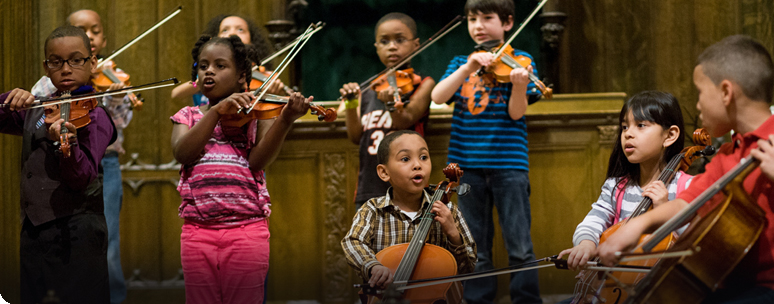
Saturday cello class
BSO violists give masterclassOn Friday, two Boston Symphony Orchestra violists visited All-Play Day to give a masterclass. In the photo above, Ed Gazouleous and Kazuko Matsusaka worked with CMW student Alexis Nelson. New Urban Arts is moving!
Congratulations to New Urban Arts on the purchase of a new storefront studio and office space, just steps away from their current location (and even more convenient to White Electric)! Read all about it on NUA's blog. Jonathan Biss fundraiser photos
Many, many thanks to Jonathan Biss for donating his performance last Monday evening to benefit CMW. An amazing advocate for CMW since 2003, Jonathan told a capacity audience that "Beethoven is the most human and idealistic of composers, and CMW is the most human and idealistic of music organizations." He also publicly announced his pledge to return to Providence to perform annual recitals to benefit CMW for the duration of his 9-year Beethoven Sonata recording project for Onyx Classics. -Heath Marlow, CMW staff PS-Like piano music? On Friday, May 20, acclaimed concert pianist and Brown medical student Naida Cole will peform a solo recital to benefit Brown University's Medical Annual Fund. Download the flier here. Ravel and Golijov at Monohasset MillCongratulations Ariana!
This is my seventh marathon, and my fourth time running Boston. This was a challenging year for training–the extraordinarily snowy winter blanketed us all. I had some memorable long runs–a freezing, sunny 18-miler on packed snow down by the Blackstone river, a couple of 20s on beautiful country roads in Seekonk and Rehoboth, a snow-blown trek next to the Connecticut River in Vermont, watching the sun come up over the killer hills of East Providence, and countless trips in snow and worse up and down the Woonasquatucket River greenway in the West End. A marathon is an incredible emotional journey, and the training no less. Media Lab tourIn the fall of 2009, CMW received funding from The Champlin Foundations and The Rhode Island Foundation to launch a new initiative called Media Lab. Born out of the organization's desire to document student work, support the creation of new work, and the recognition that a media environment could be a space for students to gain valuable professional technical skills, Media Lab classes began in February 2010. The first classes, in electronic music composition and video making, were taught by volunteers from Brown University (Betsey Biggs and Henry Kerins) and RISD (Anne Reinhardt) with support from Media Lab Director Jori Ketten. Last fall, Jori and former CMW Fellow Laura Cetilia co-taught a class that focused on Steve Reich's Different Trains. The PSQ performed Different Trains at the end of the semester at The RISD Museum, and Media Lab students' final projects were also shared at this event. This spring, Jori and Laura are co-teaching classes about Documentary Production and Audio/Visual Composition. Support from a team of very generous volunteers, including Micah Salkind, David Lee, Emma Cunningham, Justin Rosengarten, and Stephan Moore, has been crucial. The Media Lab website is a key part of the Media Lab program. The site is still new to CMW, and it has yet to be fully integrated into the lives of all of CMW's teachers and students. If you want to see a good example of the future potential of the website, check out how Sara has successfully incorporated Media Lab into her teaching toolbox, corresponding with students and posting information for them regularly. Built on a blogging and publishing platform called WordPress, the site is able to accomplish many things: 1. It is a storage facility for student work. 2. It is a way to log classroom activities. 3. It is a way for teachers and students to communicate. 4. Alumni can stay connected to CMW. 5. The site is expandable, meaning that classes, students, teachers, projects, and content can be added each year. Over time, the catalog will grow and students can see how their work has matured and changed over the years. Media Lab has the potential to play an important role in increasing students' agency and participation in the wider world, two areas that were addressed in CMW's 2009 program evaluation. As CMW continues to explore the vast potential of its Media Lab programming, I hope that you will enjoy visiting the Media Lab website and searching its contents. -Jori Ketten, Media Lab Director Golijov string quartet program notesOsvaldo Golijov: The Dreams and Prayers of Isaac the Blind (1994) The final work that the Providence Quartet will explore as part of the NEA's American Masterpieces grant comes from the unique voice of the Argentinean born, Osvaldo Golijov. Born in La Plata in 1960, his style was created by the convergence of several different genres. Born to a piano teacher mother and a physician father, themselves émigrés from Russia, he grew up engulfed in liturgical Jewish and secular Klezmer styles of music, traditional Western chamber music, and of course being an Argentine, the passion of the Tango and its master, Astor Piazolla. It is at the cross-section of these styles that Golijov‟s voice was born. Inspired by the Argentinean-Jewish clarinetist Giora Feidman, a great exponent of both classical and klezmer styles of playing, of The Dreams and Prayers of Isaac the Blind Golijov himself writes, “I have attempted here to integrate two strong musical traditions into a single world.” The title of the work, written for clarinet and string quartet, refers to a rabbi who lived in France from 1160-1235 A.D. Here are thoughts from the Boston-based composer himself about this work (presented here with permission from Boosey & Hawkes): Eight centuries ago Isaac The Blind, the great kabbalist rabbi of Provence, dictated a manuscript in which he asserted that all things and events in the universe are product of combinations of the Hebrew alphabet's letters: 'Their root is in a name, for the letters are like branches, which appear in the manner of flickering flames, mobile, and nevertheless linked to the coal'. His conviction still resonates today: don't we have scientists who believe that the clue to our life and fate is hidden in other codes? Isaac's lifelong devotion to his art is as striking as that of string quartets and klezmer musicians. In their search for something that arises from tangible elements but transcends them, they are all reaching a state of communion. Gershom Scholem, the preeminent scholar of Jewish mysticism, says that 'Isaac and his disciples do not speak of ecstasy, of a unique act of stepping outside oneself in which human consciousness abolishes itself. Debhequth (communion) is a constant state, nurtured and renewed through meditation'. If communion is not the reason, how else would one explain the strange life that Isaac led, or the decades during which groups of four souls dissolve their individuality into single, higher organisms, called string quartets? How would one explain the chain of klezmer generations that, while blessing births, weddings, and burials, were trying to discover the melody that could be set free from itself and become only air, spirit, ruakh? The movements of this work sound to me as if written in three of the different languages spoken by the Jewish people throughout our history. This somehow reflects the composition's epic nature. I hear the prelude and the first movement, the most ancient, in Arameic; the second movement is in Yiddish, the rich and fragile language of a long exile; the third movement and postlude are in sacred Hebrew. The prelude and the first movement simultaneously explore two prayers in different ways: The quartet plays the first part of the central prayer of the High Holidays, 'We will observe the mighty holiness of this day…', while the clarinet dreams the motifs from 'Our Father, Our King'. The second movement is based on 'The Old Klezmer Band', a traditional dance tune, which is surrounded here by contrasting manifestations of its own halo. The third movement was written before all the others. It is an instrumental version of K'Vakarat, a work that I wrote a few years ago for Kronos and Cantor Misha Alexandrovich. The meaning of the word klezmer: instrument of song, becomes clear when one hears David Krakauer's interpretation of the cantor's line. This movement, together with the postlude, bring to conclusion the prayer left open in the first movement: '…Thou pass and record, count and visit, every living soul, appointing the measure of every creature's life and decreeing its destiny.' But blindness is as important in this work as dreaming and praying. I had always the intuition that, in order to achieve the highest possible intensity in a performance, musicians should play, metaphorically speaking, 'blind'. That is why, I think, all legendary bards in cultures around the world, starting with Homer, are said to be blind. 'Blindness' is probably the secret of great string quartets, those who don't need their eyes to communicate among them, with the music, or the audience. My homage to all of them and Isaac of Provence is this work for blind musicians, so they can play it by heart. Blindness, then, reminded me of how to compose music as it was in the beginning: An art that springs from and relies on our ability to sing and hear, with the power to build castles of sound in our memories. Download Jesse's complete program notes for the season-long series here. May 9: All-Beethoven recital by Jonathan Biss
Pianist Jonathan Biss, a founding member of CMW's advisory council, has agreed to perform an all-Beethoven recital to raise money for CMW. And not just one recital, but possibly a series of Beethoven recitals over the next several years while he is engaged in recording all of Beethoven's 32 piano sonatas for EMI Classics. You may recall that Jonathan's performance of the Brahms Piano Quintet with the PSQ at the West End gym in 2004 was detailed in Alex Ross' article featuring CMW in The New Yorker. Here's a New York Times article by Allan Kozinn previewing Jonathan's Carnegie Hall solo recital debut in January 2011. Jonathan's first fundraising recital is scheduled for Monday evening, May 9 in Avery Piano's Recital Room in downtown Providence. He will perform four sonatas, including Opus 10, No. 1, Opus 26, Opus 81a, and Opus 22. Seating is limited, and there is a suggested minimum donation of $50 per person. Please contact Liz Cox to reserve your seat for what promises to be a memorable evening. -Heath Marlow, CMW staff Podcast: Who Made Us Creative?A podcast is available from last week's Who Made Us Creative? conversation at New Urban Arts. The conversation was between founders and current leaders from CMW, AS220, New Urban Arts, and The Steel Yard about what it means to start and sustain organizations which support creative practice in Providence. Representing CMW, Chloe and Heath filled in for Sebastian (who was on his was to DC to participate in a Congressional briefing on arts education… more on that at a later date.) Listen to the pocast here and learn more about NUA's series of conversations on creative practice here. |