Blog

Gustavo Dudamel on 60 Minutes

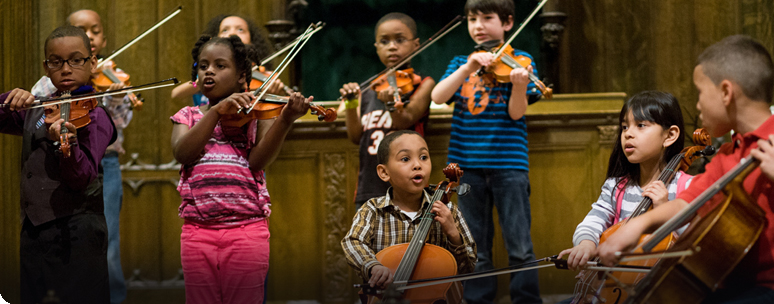
60 Minutes recently followed up on its earlier interviews with Gustavo Dudamel about his new job as the conductor of the Los Angeles Philharmonic as well as the progress being made with regard to bringing Venezuela's "music education miracle" to children in this country. For instance, in South Los Angeles, 3-year-old Youth Orchestra Los Angeles (YOLA) is providing four hours of free after-school music education to 300 children four days per week. Other initiatives inspired by El Sistema are taking shape in Baltimore, New York City, and elsewhere.

Teach music for Canada!

[This year's "Alternative Models" Fellowship Seminar featured presentations by Aaron and Carole for an audience of CMW staff, Board members, and participants in CMW's 3rd Institute for Musicianship and Public Service.]

My presentation focused on five issues, drawing inspiration from various organizations that have come up with novel solutions. I developed a model based loosely on Teach for America wherein recent graduates of music universities and conservatories would be recruited to launch music programs in rural Canadian schools.

I proposed as the mission statement of my organization:

Teach Music for Canada aims to ensure that children have equal access to quality music education in schools. We will build a new generation of music educators by drawing on outstanding recent graduates and empowering them to develop innovative music programs. By engaging students through practical music instruction, we can nurture creative thinkers, problem solvers, and active community members. It is our hope that these students will become ambassadors for quality music education in schools.

-Aaron McFarlane, Fellow

Click here to download Aaron's PowerPoint presentation in pdf format.

Strategic Plan

In February 2010, CMW’s Board of Directors approved a new Five Year
Strategic Plan. Subtitled "Deepening our Roots and Spreading the Word," the plan addresses what we feel are our primary challenges as an
organization: to extend the impact of our work (reaching more
people in more places), while at the same time deepening our
local programming (reaching deeper with our students and community in Providence’s West Side neighborhoods).

One major initiative for the next five years is "to develop and implement a space plan appropriate to our
neighborhood residency and growing space needs, add additional staff
hours to support new and continuing activities, and think through our
needs of an endowment and/or capital fund to support staff and space
needs."

To that end, CMW has hired local architecture firm 3SIX0 for a feasibility study that will help us determine what our physical space needs are. Chris Bardt and Kyna Leski describe their efforts with CMW this way:

Establishing relations is the function of architecture. The demographic divisions created by socio-economic forces dictate budgets that stratify buildings and divide neighborhoods. We feel that an acceptance of these divisions undermines the essential purpose of architecture in society. We feel that this project is truly in its essence asking for the essential core of what architecture is.

Read all about the Strategic Plan on the Profiles page of CMW's website.

Media Lab writing

Josh

1. If your piece were posted on the CMW website, how would you introduce it?

Our piece is a sample of a viola thrown down 12 notches and made it sound like an acoustic bass. Yeah it pretty much kicks butt in every sense. We [Paul and I] are planning on just freestyle playing on this. It was a Black Violin influence. Shouts to Henry! This will be available for everyone for free to play on. This piece is rugged and street but ambient at the same time.

2. If you were going to tell a friend about this class, how would you describe it? What did we do? What did you learn?

We get on a Mac and use Logic Pro and make hits. Monday is my favorite day of the week because I would come make good music.

3. Has this class affected the way you think about music? How?

I appreciate all types of music now. This class helped me understand the amount of work involved in making all types of music.

4. Has this class affected the way you play or study your instrument?  How?

I study more rhythms and different instruments. Also, I pay more attention to keys and melodies.

Paul

1. If your piece were posted on the CMW website, how would you introduce it?

I partnered up with Josh to work on a piece. In our piece we recorded ourselves playing our instruments and then put the recording on the computer. After, we made a beat using a keyboard. The keyboard we used could be used to sound like a drum or a violin or anything else. After we made the beat with the keyboard, we added the recording of ourselves. At first, the recording didn't match up with each other so we altered the recording to sync with the beat. Shout out to my boy Henry.

2. If you were going to tell a friend about this class, how would you describe it? What did we do? What did you learn?

If I was to describe this class to a friend I would tell them that this class is dead bangin'. We use a program called Logic Pro to make beats and we can record ourselves playing our instrument and sync it with the beat. So the class is fun.

3. Has this class affected the way you think about music? How?

This class has affected my thinking on music in a way that allows me to realize I can do so much work with music besides playing just sheet music.

4. Has this class affected the way you play or study your instrument?  How?

This class has affected how I play my instrument because I don't always have to play classical music.

Alana

1. If your piece were posted on the CMW website, how would you introduce it?

In the first half of my piece you're at a night club. Also in this part I included an improvisation part. Then once this part finishes, you are now waiting for the bus. You are now on your way home. I also used an improvisation part in this. In both sections I included a recording of me and Angie from when we were taking our expedition with Micah and Paloma. When I shared this piece at the Performance Party it was very exciting because I saw many people nodding their heads to my beat. It was very fun! But I also have to give props to Logic Pro because I found many loops to create my piece there.

2. If you were going to tell a friend about this class, how would you describe it? What did we do? What did you learn?

If I were to describe Media Lab to my friend I would say, "It's a class I go to every Monday and we make our own tracks on this program called Logic Pro. This program allows me to share my favorite styles."

3. Has this class affected the way you think about music? How?

This class has affected the way I think about music now because I see that you can take all different styles of music and it can still sound awesome and cool.

4. Has this class affected the way you play or study your instrument?  How?

This class has affected the way I play and study music because now I can always take my violin and improvise over my piece.

Kim Kashkashian’s CMW residency

We're thrilled to welcome violist Kim Kashkashian to Providence next week! A recent addition to CMW's Advisory Council, Kim will join the Providence String Quartet for two performances of the Brahms Viola Quintet in F Major, first at the John Hope Settlement House on Friday evening and then at The RISD Museum on Saturday.

Kashkashian

In recent seasons, Kim has appeared as soloist with the major orchestras
of New York, Berlin, Vienna, London, Milan, Munich and Tokyo. She has
performed recitals at the Metropolitan Museum and the 92nd Street "Y" in
New York City, in Boston, Washington DC, Philadelphia, Pittsburgh, San
Francisco, Cleveland and Los Angeles. Kim has performed with
the Tokyo, Guarneri, and Galimir Quartets, and toured with a quartet
which included Gidon Kremer, Daniel Phillips, and
Yo-Yo Ma.

Her extensive teaching activities have included professorships
at the University of Indiana and in Freiburg and Berlin, Germany. In
2000, she joined the faculty of the New England Conservatory in Boston.

Click here to listen to a recent interview with Kim on National Public Radio.

RICCO golf tournament will benefit CMW

NEW-RICCO-LOGO-generic

Excerpt from an email from Kathy Swann, President of the Rhode Island Civic Chorale and Orchestra:

RICCO has named Community MusicWorks as the designated organization to receive a portion
of the proceeds from our golf tournament. We are so pleased to support
your important work with children and music! It is
especially important for RICCO to support youth string programs because
we have a commitment to perform with live orchestra, using composers'
instrumentation and not score reductions. Our mission is to promote
great music through performances with chorus and orchestra and through
outreach to young people. This is the first time we've decided to
include fund raising for a youth music program in our own work and I am
so glad that Community MusicWorks will be our partner in this.

To learn more about the RICCO's benefit golf tournament and dinner on Sunday, June 13, please click here to download an informational flier or visit the RICCO's website.

Bartok’s String Quartet No. 5

The Providence String Quartet will perform and discuss Bartok's String Quartet No. 5 in a "preview" event at the Providence Athenaeum on Wednesday, May 12. Visit CMW's website calendar for details.

Having transcribed and cataloged thousands of folk songs from all over Eastern Europe and even some from North Africa, Béla Bartók, along with his compatriot and colleague Zoltán Kodály, invented the field of ethnomusicology. Bartók’s music is an amazing synthesis of traditional Western-tonality and authentic Eastern European/Magyar folk music.

Bartók's String Quartet No. 5 is composed in five movements in a large, palindromic structure. At the core of the quartet is quickly flowing scherzo with a distinctive Bulgarian swing of 9 beats to a bar distributed in a limping 4+2+3. The inner wings of the quartet are slow hypnotic examples of Bartók’s “Night Music,” the sounds of the Hungarian countryside in the evening with bugs, birds, and things that croak. The outer wings are a sonata form first movement and a rondo finale. The first movement itself is a palindrome as the three themes from the exposition are restated in the recapitulation in reverse order and upside down!  The finale zips along with tremendous force until a banal hurdy-gurdy gives pause before the final thrust to the finish. 

Commissioned by the Elizabeth Sprague Coolidge Foundation in Washington, Bartók wrote his Fifth String Quartet in an unusually short amount of time, from August 6 to September 6, 1934. The Quartet received it’s premier in Washington by the Kolisch Quartet on April 8, 1935.

-Jesse Holstein, PSQ

Students

Teachers

Classes

Performances, Events, Projects