Reminder: May 20-23 IMPS applications are due March 15.
Blog
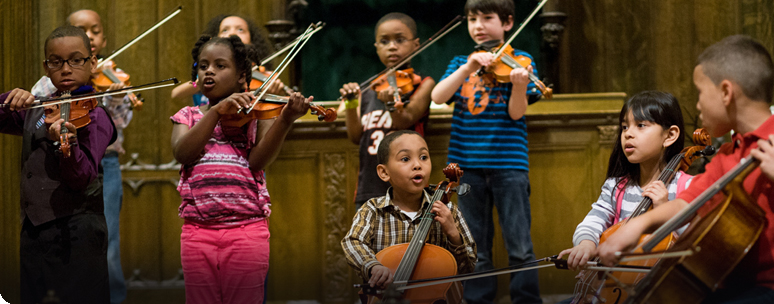
Sights and sounds from the November 2009 IMPSReminder: May 20-23 IMPS applications are due March 15. March 2008 conference documentationThanks to Jori, documentation of the March 2008 Imagining Art + Social Change conference is available in the form of a beautifully designed 38-page book. You can order your own copy of the book at blurb.com for $19.95, where you can also enjoy an online preview!
I was completely in love with the idea of playing string quartets professionally but really disenchanted with where people traditionally play string quartets and how its done. Simultaneously, I was very intrigued with the idea of music playing a role in education and specifically a role in transforming people's lives. I was working at Brown on some independent projects on music and moral education and finding those books and those conversations somewhat too oriented around what's good behavior and what's not good behavior. That's not the idea of moral education that I was fascinated with. I was more interested with what music can stir in someone's inner life in a very significant way that would make them want change personally. -Sebastian Ruth You can also find all sorts of documentation of the conference at CMW's website (also available thanks to Jori). -Heath Marlow, CMW staff Carole’s note reading classDuring February vacation's "Teaching Intensive Week," several CMW staff led special classes, including pilot classes designed for the parents of CMW students. Carole offered a class to help parents learn the basics of reading music. Here are a few excerpts: Looking at a piece of music We constantly are using terminology and symbols to write down these musical concepts to understand them. I often describe it as learning another language, because there are so many different small details to memorize and integrate into your thinking. When we first look at a piece of music, there are a few basic things that you will always see, and identifying these things is key to understanding how the musical notation on the paper relates to the music that we hear all the time. Pitch is exactly how high or low a sound is. Note is the symbol we use to write pitches down on paper. The different parts of notes are head, stem, flag. The Staff is the five lines and four spaces where we put our notes. Each line and space is given a name from the musical alphabet: A-B-C-D-E-F-G-A, and it repeats indefinitely. At the beginning of a staff, you will see a clef. The clef tells you the name of each line and space. Each clef has a way of showing you where the notes fall on the staff that it is fronting. There are four different clefs, treble, bass, alto, and tenor. The clef is dependent on the instrument it is written for. Treble clef is also called the G clef, it loops around the G-line on its staff. Higher ranged instruments like the violin, flute, guitar, or trumpet read music in treble clef. Bass clef is also called the F clef, because its hook and two dots show you the F-line on its staff. Lower ranged instruments like the cello or double bass read music in the bass clef. The longest note you will have is a whole note. You can compare shorter note values to a whole note. When thinking in terms of note lengths, we often use fractions to determine the lengths of notes. Rests are symbols that show you where the silences are in a piece of music. Every note value has a related rest of the same value. Accidentals are symbols that indicate how a note can be altered in sound. There are three different accidentals. A sharp (#) will raise the pitch of a note by one half step. A flat ( Scales are groups of notes arranged in steps, just like a staircase. It starts and ends on the same note. There are major scales and minor scales. March 16 is Arts Advocacy DayAccording to Lisa Carnevale of RI Citizens for the Arts, if Governor Carcieri's proposed budget cuts are enacted, "these cuts will have a devastating affect on the creative community and beyond. This budget proposal would eliminate the public art program, the film tax credit and discretionary grant funds, a total cut of 58% – causing a severe hit to the many arts and cultural institutions in our state that liven our cities, attract businesses and jobs, hire locally, buy locally and contribute largely to our economic welfare." CMW's Phase III teens will be visiting the State House on March 16 during Arts Advocacy Day to share their musicianship and their opinions. In the words of one CMW teen, "I am a completely different person because of [Community MusicWorks]. Being in CMW has given me the opportunity to be a leader among friends, to express myself, to make my voice be heard, to be confident, to be spontaneous, and to be someone who is willing to help."
Want to join Phase III at the State House? Visit RI Citizens for the Arts to learn more about Arts Advocacy Day. -Heath Marlow, CMW staff Census jobs availableA civic engagement opportunity and a chance to earn extra money. Any CMW parents or other residents of Providence, Central Falls, or Pawtucket interested? Read on… The United States Census counts every resident in the United States, and is required by the Constitution to take place every 10 years. The 2010 Census will help communities receive more than $400 billion in federal funds each year for things like hospitals, job training centers, schools, senior centers, bridges, tunnels and other-public works projects, and emergency services. The data collected by the Census also help determine the number of seats your state has in the U.S. House of Representatives. Any personal data collected is protected under federal law (nor will be shared with any other branch of the US government). The Providence County Census office is seeking applicants who reside in Providence, East Providence, North Providence, Central Falls and Pawtucket for jobs that will start in the Spring of 2010: Field Operation Supervisors, Crew Leaders, Crew Leader Assistants, Census Takers. Census Takers within these areas will make $15 – $16/hour and their Supervisors will make up to $19/hr. Hundreds of part-time and full-time positions will become available throughout the state. It will be a great opportunity to earn good, quick and relatively easy money during these hard economic times. Applicants must be at least 18 years old and present valid forms of ID: passport, permanent resident card, driver's license, social security card, etc., and pass a 30-minute basic skills test. Bilingual speakers are encouraged to apply. Call 401-228-0920 during normal business hours for information. IKEA to the rescueAfter weeks (or was it months?) of agonizing over color palettes, types
The official christening will take place -Chloe Kline, CMW staff Open Media Lab HoursWe had an awesome "Media Lab Open Hours" session on Saturday. Henry
-Jori Ketten, Media Lab Director Sponsor the CMW Pavement RaidersThe CMW Pavement Raiders are currently training for the Providence 5K
Last year was the first time we offered a summer camp for our students, Interested in sponsoring the 11-member CMW team? Our goal is to raise $2,010. Learn more by visiting our fundraising page: http://www.firstgiving.com/cmw5k Thanks for helping out! -Heath Marlow, CMW staff Coming soon: St. Lawrence String QuartetEleven years ago, the Emerson String Quartet was auditioning younger One tape, from a young Toronto quartet, juxtaposed the Creative DisruptionMessage for Sebastian: According to a recent study that is available at Third Sector New England, sabbaticals for nonprofit leaders can be "a relatively inexpensive but
This study "exposes the myth that an executive sabbatical will be a Side effects may include an increase in organizational capacity as staff assume new roles, strengthened governance resulting from planning for the sabbatical, and rejuvenated executive directors with fresh ideas and perspectives. Do not continue for longer than three months without consulting a physician or Liz Hollander. |

 b) will lower the pitch by one half step. A natural (