Blog

Program Notes: MusicWorks Collective Season Opening Concert

Enjoy this deep-dive into the compositions on Sunday’s program, then make your reservation to join us at the CMW Center!

José Manuel Joly Braga Santos: Concerto for Strings in D
Notes by Jesse Holstein

A highly accessible work, the first movement opens forcefully with a stately, muscular  theme in the violins atop insistent pounding below in the lower strings. A spaciousness opens up and we hear Kimberly, Miguel, and Sebastian singing out a melancholy tune that seems to pay homage to Ralph Vaughn Williams or Big Ralph (as he was not called by anyone). The tempo quickens with a recycled snippet from the opening theme and we are off on a frenetic and determined scamper. Akin to a Baroque Concerto Grosso,  the solo violin and  cello emerge from the texture prior to the movement’s impassioned and lyrical second theme. After a brief development and recapitulation, the movement closes quietly with three pizzicatos by guest artist Justin McCarty on the double bass.

The second movement opens with a repetitive march-like dirge that sets up a somber and heartfelt violin theme. This movement was actually played at the composer’s own funeral in 1988. The procession pauses briefly in the middle of the movement for an emotional release before returning to the elegaic march from the beginning. This time, we hear the melody sung by a solitary viola and some elegant variations in the second violins. 

The English influence is again unmistakable in the final movement. A country dance skips across the landscape in a sunny D-major. Something is a bit peculiar however as Santos chooses a meter of 5 beats per bar instead of the customary 2 or 4,  giving the musical flow a unique lilt. Written in a rondo (or refrain) form, Santos has some fun deconstructing the melody harmonically and rhythmically in the episodes between the statements of the main theme. An acceleration  and drive to the end closes a very satisfying work by an unjustly unknown voice.

Hawa Kassé Mady Diabaté: Tegere Tulon
Notes by Professor Lucy Durán

Tegere Tulon revisits the handclapping songs of Hawa Diabaté’s childhood, which were such formative experiences for her, and which are gradually dying out except in remote villages. Performed exclusively by girls outdoors in a circle, usually on moonlit nights, the handclapping songs are normally very short, consisting of one or two phrases repeated in call and response, often involving counting, each one with its own dance. Children make them up spontaneously, using the rhythms of language to generate musical rhythm, with playful movements, some individual, some coordinated by the whole circle.

Building on her own memories of the handclapping songs she used to do as a young girl in Kela, Hawa has created four new pieces in handclapping style, which she hopes will encourage Malians not to abandon this rich cultural heritage. The lyrics are humorous and poignant—they talk about the importance of family, the teasing relationship between kalime “cross-cousins” (a man’s children and his sister’s children are cross-cousins), a girl who loves dancing so much she falls into a well and then climbs out, and how long it takes to get to Funtukuru, her husband’s village, where she went to film handclapping.

Read the full program notes here

Merlijn Twaalfhoven: Play
Artist statement by the composer

“What is music making? Is it high performance? Or can it be … play? Is it the delivery of an achievement with set expectations or can it be open to the moment, challenge the players and connect everybody?

In the classical music of today, the separation of performer and listener is very strict and clear. We might forget how for centuries (and still today, outside the conventional concert halls), music was the most effective way to connect, to create together, to participate, to play. Both in religious service as in celebrations or ritual, music establishes a sense of unity.

Today, our society is fragmented and divided. Can musicians play a role to create new forms of connectedness and community? In this composition, I invite all people that are present to contribute and … to play.”

Play and Tegere Tulon were composed for 50 For The Future: The Kronos Learning Repertoire. Learn more about the project here

Antonín Dvořák: Piano Quintet
Notes by Jesse Holstein

Atop the gentle lilt of the piano, a most lyrical and touching opening theme in the cello begins our journey. Suddenly, a dramatic emotional and harmonic pivot injects a serious and rhythmic energy to the narrative. Written in the customary sonata-form,  the wistful second theme is introduced by the viola before being picked up by others. Dvořák’s ability to present both themes through multiple emotional hues is on full display in this large-scale movement. After a development section playing with both principal themes, a recapitulation and a monumental coda bring this deeply rewarding first chapter to a close. 

Part of the confidence that Dvořák found with his acceptance by Brahms and Simrock, and subsequently the musical establishment, was the courage to be himself and to celebrate his Bohemian heritage. The middle two movements of the quintet pay homage to his background with two of his favorite Czech dances as the vehicles: a stately and elegant Dumka followed by a scampering Furiant. The second movement Dumka  follows a customary roadmap of quicker, more upbeat interludes between the somber main theme. It is none other than the viola (one of his primary instruments) that presents the Dumka theme at the outset. 

While the third movement is marked Scherzo, Dvořák parenthetically added Furiant to the title. While it lacks some of the usual rhythmic idiosyncrasies of a traditional Furiant, the intent is to possibly inject some Furiant-like energy into the mix after the elegiac Dumka. The trio captures a wonderfully spacious nostalgia that ironically employs some of the rhythmic characteristics of a typical quick Furiant before the return to the quicker opening material.

The finale opens with a bristling expectancy before a most satisfied and joyous melody in the first violin lets us know that this is going to be a fun conclusion to the work. Indeed, in this proverbial “victory-lap” finale, Dvořak fully squeezes every expressive and compositional drop out of the main theme and the warm, dancing second theme.  Packaged in a rondo structure, he has tremendous fun with both themes using imitation, call and response, games of tag, a raucous Bohmian Fugue, and towards the end, slowing the main theme down very slowly into a stately chorale before the final push to the finish line. 

Intrigued? Make your reservation for Sunday’s concert!


Program Notes: Back to Spirit and Feeling

When choosing music for the Sonata Series, I was imagining the vibrant sound space of the new performance hall in the CMW Center. In some ways, this could have been an opportunity for celebratory music. But the moment in our world and in this season called me toward the interiority of our experience. Music that draws on our rich lives of spirit and feeling, and that may bring us back to these places.

Discovering that our friend and former CMW colleague Jessie Montgomery crafted the short work Peace as a response to grappling with sadness in 2020 was a lightbulb moment. It felt like a perfect opener to a set of pieces framed around the magisterial world that is Arvo Pärt’s Fratres. Fratres has always been one of those pieces that seems to stand outside the currents of other music—it is activity and stillness that makes you feel like bowing in reverence to something eternal.

What could follow? The slow movement of the Vieuxtemps sonata emerges from stillness and goes into lush tender feeling, drawing us out of the reverence of Pärt, and into an emotional reverie that can carry us home.

I’m excited to explore the arc of these three beautiful works as a set together at Thursday’s concert.

–Sebastian Ruth, violist

Join us Thursday, February 13 at 7 pm at the CMW Center to hear these pieces performed by Sebastian with guest pianist Ivan Tan, along with a performance by Walter Muelling with Ivan of Gilbert Galindo’s Sonata for Viola and Piano. 

Sonata Series Event #2
Thursday, February 13 at 7 pm
The CMW Center
1326 Westminster Street, Providence

**SEATS IN THE PERFORMANCE HALL ARE SOLD OUT, BUT PLEASE JOIN US IN THE COZY CAFÉ AT THE CMW CENTER TO ENJOY A HIGH-QUALITY LIVESTREAM OF THE EVENT! NO RESERVATIONS ARE NECESSARY.**

Make your reservation here
This event is free, with an option to support CMW with Choose-What-You-Pay pricing:
$25 adult
$20 senior
$5 student
CMW students and their families: Free


Watch a Dream Come Alive

“The block party was truly transformative. It was magical. The building was alive.” -Chris Bardt, Principal, 3SIX0 Architecture

 As 2024 draws to a close, we’re thrilled that this year has brought the culmination of over a decade of dreaming, planning, and hard work with the opening of the Community MusicWorks Center. As students and community members fill the halls with music, life, and joy, we’re excited by the possibilities this new space brings.

We’re grateful to YOU, along with the many people who have come together to build this home for our community of young musicians. Your thoughtful input, gracious support, and unwavering vision helped to make it come alive.

Thank you!

We hope you’ll join us in celebrating this important milestone by making your year-end gift to support the innovative programming and vision of Community MusicWorks, and joining us for a concert soon!

Best wishes for a Happy New Year,
The Community MusicWorks Staff

Make your gift to CMW

View our events calendar

Join our enews & mailing list

The Paper Instruments Project

In the Daily Orchestra Program, students’ musical journeys start with playing paper instruments before graduating to their real wooden instruments.  This year, our luthier Erik Talley created a new-and-improved model that looks and feels like the real thing! Students enjoyed learning about instrument care and technique, as well as painting and customizing their very own paper instruments to take home.  Many thanks to Erik and our wonderful volunteers for making this meaningful and adorable project possible. Video by the also wonderful Lisa Sailer.

CMW Hosts Community Leaders in a Building Preview

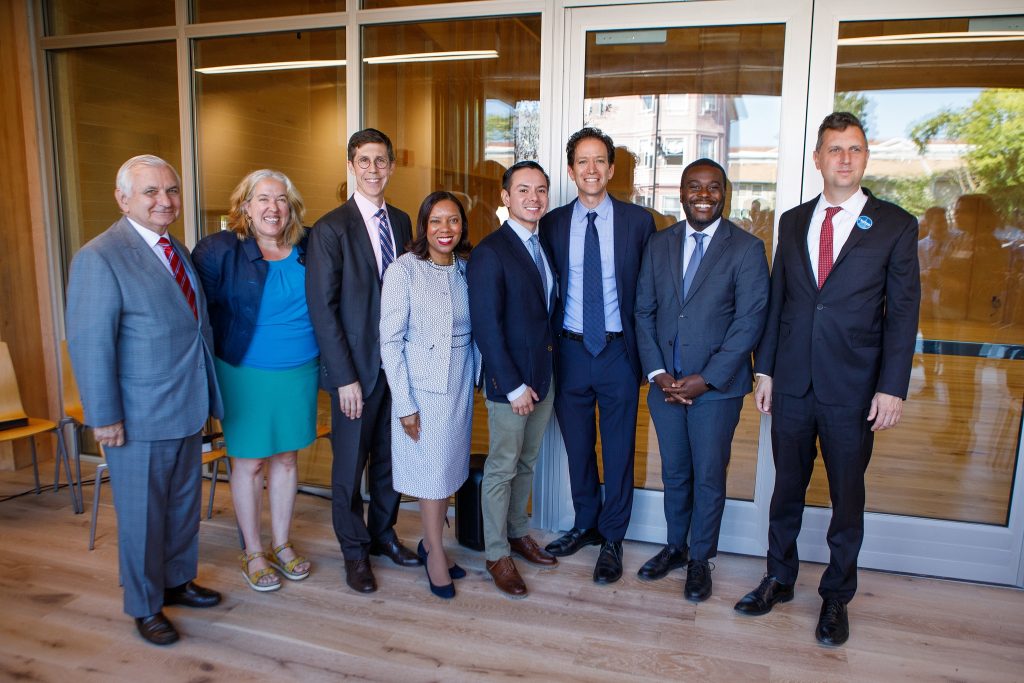
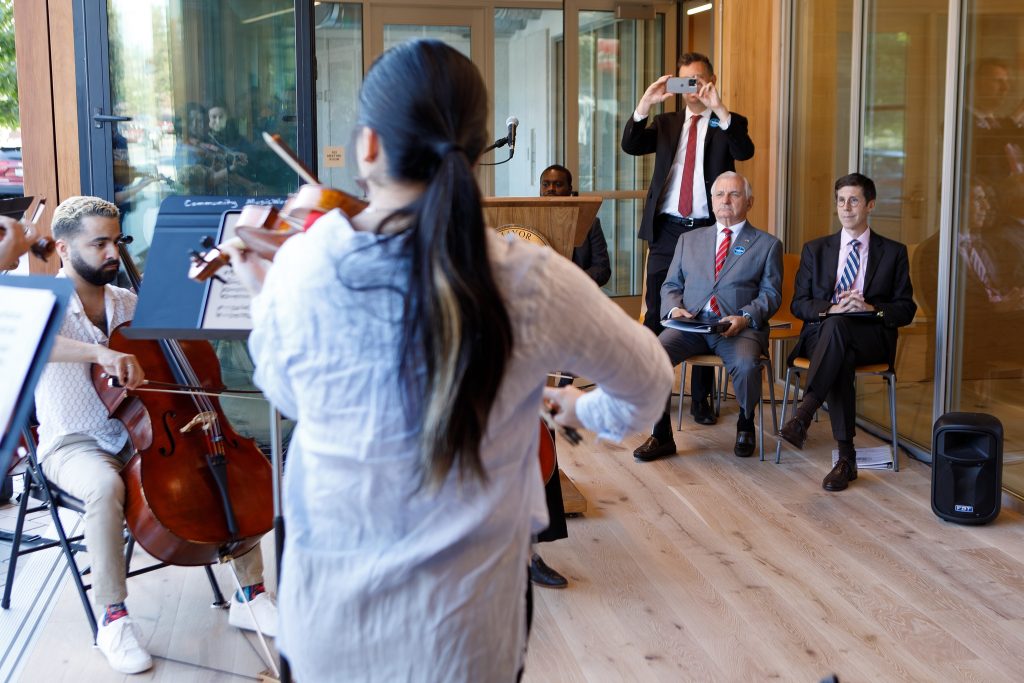
CMW welcomed elected and community leaders to a recent preview event: Senator Jack Reed, Councilwoman Rachel Miller, Mayor Brett Smiley, Lt. Governor Sabina Matos, CMW Board President Ramiro Encizo, CMW Founder & Artistic Director Sebastian Ruth, Congressman Gabe Amo, and Representative Seth Magaziner.

This week, CMW hosted a first look of our dynamic new building and performance space for elected and community leaders. This kickoff marks a new chapter for the organization as we move from a small storefront to a 24,000 square foot center, which will open to the public for the first time at a Grand Opening Celebration on Saturday, September 28.

“Access to music and arts education can be a transformative force in the lives of young people. For nearly 30 years, Community MusicWorks has been bringing music into the lives of Rhode Islanders and fostering connections through lessons and performances,” said U.S. Senator Jack Reed. “This new facility we are celebrating today is a testament to the dedication and hard work of Sebastian and his team, helping Rhode Islanders of all ages develop and hone their love of music and passion for the arts.”

“The Community MusicWorks Center aims to be the heart of a musical community that inspires and connects. This new space will allow young people for generations to gather, make those connections, and develop their craft as musicians,” said CMW Founder and Artistic Director Sebastian Ruth, who in 2010 was awarded a MacArthur Fellowship, also known as the “genius grant,” for his work creating the organization. “We are excited for the building to inspire young people and professional artists in creative endeavors and community building.”

The new space will better serve the growing network of students, alumni, and professional musicians that benefit from CMW programs. From our humble beginnings with 15 students in 1997, the organization now serves approximately 130 students each year, engages world renowned musicians like Yo-Yo Ma and Emanuel Ax, and offers regular public concert performances as the MusicWorks Collective.


“Every child, regardless of their background, should have the opportunity to pursue their passions and interests. As a former teacher, I understand how music can serve as a creative outlet for young people to express themselves, and Community MusicWorks has done incredible work to expand access to music education and the arts for all Rhode Islanders,” said Rep. Seth Magaziner (RI-02).

“As we work to expand opportunities for young people to develop and grow their passion for the arts, I thank Community MusicWorks for their decades of service to Rhode Island,” said Rep. Gabe Amo (RI-01). “Congratulations on their brand-new space that will expand the positive reach in our community, support creative voices, and bolster music education for future generations.”

CMW purchased the lot at 1326 Westminster Street in 2017 and broke ground on the project in spring of 2022. With students slated to begin string lessons on site by mid-September, the new Community MusicWorks Center features teaching and practice rooms, administrative offices, a cafe that will eventually be open to the public, and, for the first time in the organization’s history, a designated performance hall.

“For nearly 30 years, Community MusicWorks has been a cornerstone in shaping the lives of Providence students and families,” said Mayor Brett P. Smiley. “I am grateful that our city has partners like Community MusicWorks who foster a culture or creativity and inclusivity in Providence and utilize music and community to open up new opportunities for every member of our community.”

Funding for the project came from a record $15 million capital campaign, including ARPA funds through the City of Providence, Cultural Facilities Bond funds administered through the Rhode Island State Council on the Arts, ARP funds administered through Rhode Island Housing, and New Markets Tax Credits from the Massachusetts Housing Investment Corporation. The center’s design was conceived through a series of planning charrettes with CMW students, parents, alumni, musicians, and community members, and a thoughtful focus on sustainability. It is only the second building in Rhode Island to use a Cross Laminated Timber (CLT) technique that reduces the need for carbon-emitting steel and concrete.

The public is invited to tour the building and celebrate this milestone at a free community celebration on Saturday, September 28. Doors will open at 2 p.m., followed by a world-premiere by composer Wang Lu, which includes a student procession and performance from the old space to the new at 3 p.m.

Join us!
CMW Center Grand Opening Block Party
Saturday, September 28, 2:00-7:00 pm
1326 Westminster Street, Providence.
Admission is free; Make your reservation here.


We’re grateful to our partners, who helped to bring this project to life:

James Comer
Deputy Executive Director, RIHousing
“RIHousing is proud to have provided critical funding for the Community MusicWorks Center, a multi-use facility that replaces a vacant, blighted piece of property in Providence’s West End. CMW’s Center will act as a community space for the neighborhood and a destination for those living in and around the city, its impact extending far beyond its walls. We are dedicated to continuing to invest in projects like this that, along with building more affordable housing, are integral to community revitalization across Rhode Island.”

Moddie Turay
President and CEO, Massachusetts Housing Investment Corporation
“The New Markets Tax Credit Program aims to empower low-income communities by attracting new investments and revitalizing neighborhoods. With its strong presence and longstanding relationships in the West End of Providence, Community MusicWorks has established itself as a respected local partner. Now, with the space to grow, they can further enhance their role as a good neighbor. CMW embodies the type of organization we seek to support, and we are excited to see them leverage these tax credits to create an inclusive and dynamic environment for creativity.”

Barbara Sokoloff
President, Barabara Sokoloff Associates, Inc.
“We are excited to bring financing to such an innovative, sustainable design.”

Kyna Leski
Principal, 3SIX0 Architecture
“Community MusicWorks shared a quote from Maxine Greene that serves as a guiding principle for their organization: ‘I am what I am not yet.’ Those words were an inspiration for our team as we sought to create a design that evoked an ethos of promise. From the unfinished rawness of exposed mass timber walls, beams and columns, pipes and conduits, to the mix of sheathing and exposed framing of the faceted acoustic panels in the performance hall, our architectural goals were to create a space that the community could call ‘home’ and that left open the opportunity to grow and evolve in unexpected ways.”

Alban Bassuet
Principal, Arup
“We’re proud to help realize CMW’s new home that can better support its vital mission to ensure music education for all. To create a top-notch environment for learning and performance, Arup brought the state-of-the-art acoustics design and venue planning for quality sound insulation and managing the unique properties of mass timber for music and Providence’s first mass timber building.”

Jonsara Ruth
Co-founder and Design Director, Healthy Materials Lab
Associate Professor of Interior Design at Parsons School of Design
“A healthy building is particularly important for children because it is now understood that environmental exposures can be a powerful determinant of health and human development. We are proud to partner with Community MusicWorks and 3SIX0 Architects on the new center, which both prioritizes the health of the community and inspires creativity for students.”

Tom Ardito
Director of the SNEP Watershed Implementation Grants program, a partnership between EPA New England and Restore America’s Estuaries, which funded stormwater management aspects of the building
“With this new Music Center, Community Music Works has established a space that will truly serve this wonderful organization, its constituents and the community. Most remarkable from our perspective is that CMW went beyond the requirements of a great concert and teaching space, to create a building that will be not just a cultural resource, but an environmental asset as well.  The Southeast New England Program is pleased to support this project for its positive impacts on clean water, climate mitigation, and in fostering a sustainable, creative and equitable community in Providence.”

Learn more about the CMW Center here.

Photos by Rebecca Atwood/Atomic Clock

Construction Update: Healthy Materials and Challenges Met

“Everywhere you turn on this project, there’s a small challenge.”

 While workers put finishing touches on the new CMW Center, Sebastian took a walkthrough with Pezzuco Construction representatives Ron Pezzuco and Doug Valcourt to chat about materials and features of the soon-to-be-opened project at 1326 Westminster Street.

Providence-based architecture firm 3SIX0 designed the Community MusicWorks Center to be constructed out of mass timber, only the second building in Rhode Island to be using the material as the structure of a building. The building reduces carbon-emitting steel and concrete production by using Cross Laminated Timber (CLT) as the structure. The CLT used in this project was made from gluing together 5 layers of spruce wood and was manufactured in Austria.

CMW, together with 3SIX0 and Pezzuco Construction, worked closely with Healthy Materials Lab, a design research lab at Parsons School of Design, with the goal of making a pioneering, healthy, low-embodied carbon center in the heart of the West End. All building materials and furnishings were evaluated to minimize the presence of toxins known to contribute to childhood disease.

The entire team, from planning to placement of each carefully considered element, has met any challenge in service of a healthy, light-and-music-filled place that our students, neighbors, and friends can call home.

Save the date: The Community MusicWorks Center Grand Opening Celebration is on Saturday, September 28, and we can’t wait to welcome you!

Video by Atomic Clock

Save the Date: 9/28 for the CMW Center Grand Opening Celebration!


We’re putting the finishing touches on the new Community MusicWorks Center and getting ready to move in! We look forward to celebrating this new space with you with food, fun, tours of the new building, and of course, music!

Stay tuned for more details.

Save the Date: CMW Center Grand Opening Celebration!
Saturday, September 28
1326 Westminster Street, Providence

Spring Construction Update

“It’s a learning experience for me, not only in construction but in community.”

Construction has entered another exciting phase as workers shape and outfit the interior spaces of the Community MusicWorks Center. Take a peek inside as CMW student and board member Dayana quizzes Pezzuco Construction owner Ron Pezzuco with key questions about the building’s finish date and what kind of sandwich he hopes to see featured in our café.

Learn more about the Community MusicWorks Center here.
Enjoy photos of the interior-in-progress.

“I Want People to Have a Visceral Response.” Talking with Reena Esmail


This week, CMW welcomes composer Reena Esmail to the organization for a week-long residency that includes a Q&A lunch on Wednesday and the End-of-Year Student Gala on Friday. Jill Pearlman talked with the composer in anticipation of her visit to CMW.

***

One of Indian-American composer Reena Esmail’s secrets is that she keeps a dizzying number of conversations going simultaneously, somehow making it look easy. Not just dialogs between sitar and harpsichord, but also between orchestra and the street, between Hollywood and Bollywood. She does the intricate thinking to meld these layers but wants us to enter with our emotions first.

On first hearing her music, I felt some déjà vu, as if the music stemmed from a vast ocean of origins, and those echoes, resonances and combinations have always existed – but where?  There are secrets to these compositions that Esmail holds and keeps to herself – graciously rolling them out little by little as we immerse in her lush, often provocative project.

Rigorously trained in the classical western schools, at Juilliard and Yale, Esmail had been looking for ways to step out of boxes, closed systems, assumptions.  “I think people overintellectualize music,” she says.  “Professional musicians have been trained to experience things in an exact way. When you take some of those things away, people are forced to read their own intuitions and emotions. I want people to have a visceral response. I’m trying to tap into a third rail of emotion.”

Esmail’s third rail involves not shock and confrontation, but invitation and seduction. In her words, when having intercultural conversations, “I’m inviting others to be uncomfortable in the most comfortable way.”

Her personal mélange of cultures could be infuriatingly confusing. Esmail, 41, was raised in Studio City, Hollywood.  Her parents were “super weird” — although both Indian, her mother was raised in Kenya and her dad in Pakistan, eleven languages between them but English the only one in common. The school scene meant being immersed in movie and pop culture, Spice Girls and Alana Morrisette the backdrop to hanging out with friends whose parents were stars. Bollywood was a rare nod to Indian music heard at home.  She gravitated to Western classical music and pursued a career path, entering Juilliard as an undergrad.

As a budding composer, she felt challenged by the priority of Western harmony, and found herself intuitively drawn towards melody. A year-long fellowship in India when she was 22 filled out pieces of that puzzle – she felt immediately at home in Hindustani composition, the northern Indian classical tradition, and began to study similarities and differences.

A well-known 2018 composition, “Darshan,” for instance, is based on the Bach partita. It flows so beautifully that before you know it, you’re wondering if Bach used those rich textures, that lyrical, head-rolling rhythms, the darkness and lightness.  “It works between sensibilities, taps into new western music style with texture coming in the forefront than background,” says Esmail. “A lot of the surrounding texture approximates a drone. The warmth and buzziness of Indian instruments are similar to elements of baroque music.”   (It was featured in the New York Times’ piece, “Five Minutes That Will Make You Love the Violin.”)

The acclaimed violinist known for this exquisitely expressive piece is Vijay Gupta, Esmail’s husband of four years. Also born in American to Indian immigrants, Gupta had been deeply involved with Bach’s sonatas and partitas, so he commissioned Esmail’s piece before the two were married. Another shared interest: expanding the classical music world’s narrow reach, in setting, audience and power structures.  In 2010, Gupta founded Street Symphony, a Los Angeles-based project established to play music for and with people on Skid Row, in prisons and in shelters.  The work has been appreciated and lauded, establishing community and fortifying Gupta’s urgency of being a “Citizen Artist.”  Gupta is artistic director, and Esmail was the resident composer in 2016-2018.

Being an artist, Esmail says, means “putting ourselves in service of bigger questions. We don’t spend enough time thinking about them.”  Her answer has been to create work that connects, rather than divides.  Similar to the commitment of Community MusicWorks, Esmail says, “this is not outreach, not a thing that is a separate thing from music making. This is not that different in terms of interaction.  We meet people where they are emotionally. That’s the job of artist.”

Lately this has meant asking herself how to write music that engages youth.  Over the years, her compositions for young musicians have expanded one hundred percent. She has written a band piece for high school band, children’s piano and choral pieces with Oxford University Press, written for student ensembles.  “Professional music making, we don’t value enough educational music making.  If you hadn’t played Bach’s Minuet in G as a student, would you value St Matthew Passion as an adult?”

Add to that Esmail’s much anticipated guest residency at CMW, May 14-17.  She will be testing out some of her compositions, such as “Twinkle Twinkle” with Hindustani rhythms, on a tough audience, the kids: “It will be a clear litmus test. A child doesn’t owe you anything!”

 The workshops will culminate in the End-of-Year Student Gala, May 17th at the Lindemann Performing Arts Center, where CMW staff and student musicians will celebrate by playing an Esmail program.  Watch for “Concerto for You,” a piece which embodies Esmail’s commitment to minimize hierarchies within an orchestra; the soloist, Minna Choi, will circulate and trade on and off with student musicians.  The moving conclusion embodies Esmail’s concept that this concerto is for “you.”  You who?  Gupta, her husband, asked if it was for him. Esmail turned him down and pointed to the musicians. The musicians will gesture outward from the stage –consider yourself invited, this happening is made for you.

— Jill Pearlman

Jill Pearlman worked as a music and arts journalist in New York and France for over a decade.  Now mainly a poet, writing at the edge of music and words, she lives in Providence and is a massive CMW fan.  Her work can be seen at jillpearlman.com.  

Join us for these two events:

A Conversation and Lunch with Composer Reena Esmail
Join us for a conversation and lunch with the composer, where you can ask questions, hear more about her work, and enjoy refreshments. Lunch will be provided. Join us!
Wednesday, May 15 at noon
Southside Cultural Center
393 Broad Street, Providence
Admission is free; Make your reservation here

End-of-Year Student Gala
Join us for a large ensemble performance where the event’s musical centerpiece, Reena Esmail’s composition Concerto for You, is scored for a professional violinist to play with a youth string orchestra, and our very own CMW Resident Musician violinist Minna Choi will perform as the featured soloist. Reena’s compositions combine influences from western classical and Hindustani or Indian classical music, so, we’re pleased to feature master tabla player Nitin Mitta, who’ll lay down percussion with our student ensembles and perform a sure-to-be-stunning percussion solo. Join us at the Lindemann Performing Arts Center at Brown University for this celebratory event as CMW beginner to graduating students take the stage with the MusicWorks Collective and special guests. Cheer on our young musicians, enjoy the fabulous venue, and stay for the delicious buffet! We look forward to seeing you there.
Friday, May 17 at 6 pm
The Lindemann Performing Arts Center
146 Angell Street, Providence
Admission is free; Make your reservation here.


Students

Teachers

Classes

Performances, Events, Projects