Blog

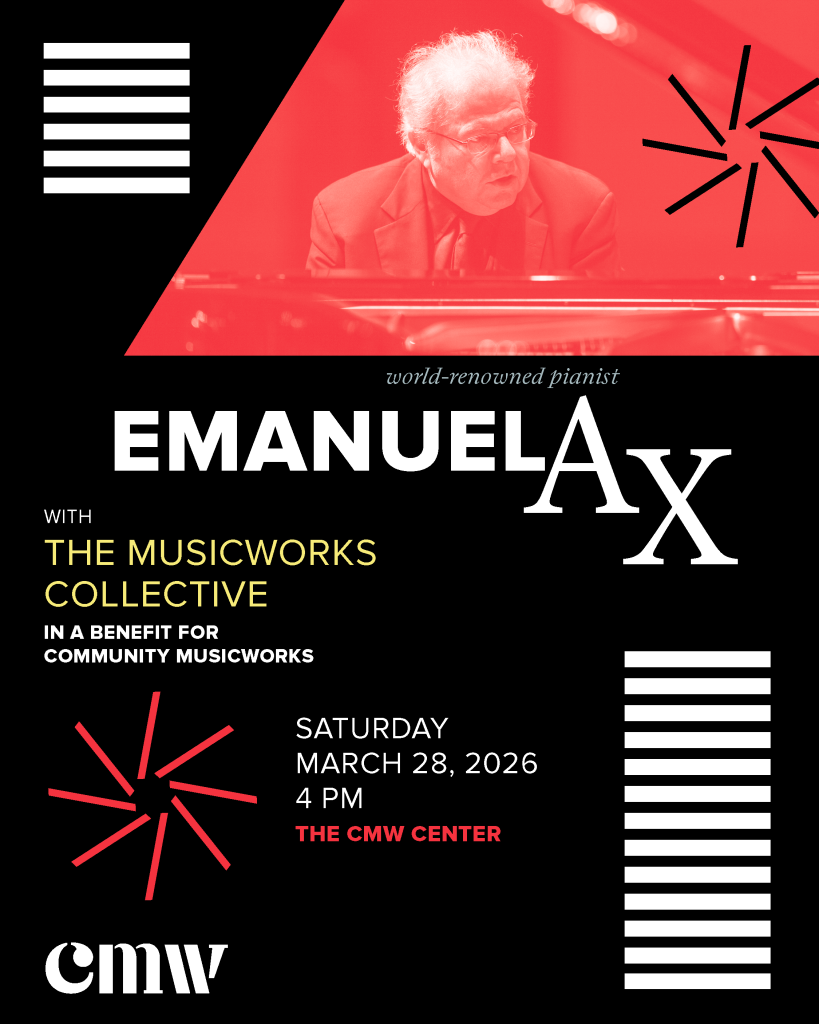
An Afternoon with Emanuel Ax in a Benefit for CMW

World-renowned pianist Emanuel Ax returns to CMW!

Join us Saturday, March 28 for an unforgettable afternoon of music. Emanuel Ax performs a program of solo works and joins the MusicWorks Collective for the sublime Mozart Piano Concerto No. 14, K. 449

This event promises an intimate, deeply expressive musical experience, set within the CMW Center Performance Hall’s state-of-the-art acoustics.

All proceeds support CMW’s free music programs, bringing the joy and transformative power of music to young people in our community. Don’t miss this extraordinary concert!

Maestro – $1,000 includes a front-row seat to the concert.
Virtuoso – $500 includes a second or third row seat to the concert.
Superstar – $250 includes a back section seat to the concert.

***Reserve your seat below***
March Events: Join Us!

In March, we’d love to see you at these three events at the CMW Center!

Youth Salon

Join our Phase II students for an engaging event featuring a panel discussion, interactive activities, and musical performances—all exploring the theme of artificial intelligence.

Youth Salon
Friday, March 6 at 6 pm
The CMW Center
1326 Westminster Street, Providence

This event is free; no reservations required.

****************************

Sonata Series Event #2

Our second Sonata Series Event features Resident Musicians Minna Choi and Zan Berry along with guest pianist Eliko Akahori for a program steeped in romanticism and deep expression. Come experience Amy Beach’s dramatic and passionate Violin Sonata and the equally affecting Cello Sonata in e minor by Johannes Brahms. You won’t want to miss this evening of music!

Sonata Series Event #2
Thursday, March 12 at 7 pm
The CMW Center
1326 Westminster Street, Providence
Reserve your seat

*************************

World-renowned pianist Emanuel Ax returns to Community MusicWorks!

Join us Saturday, March 28 for an unforgettable afternoon of music. Emanuel Ax performs a program of solo works and joins the MusicWorks Collective for the sublime Mozart Piano Concerto K.415.

This event promises an intimate, deeply expressive musical experience, set within the CMW Center Performance Hall’s state-of-the-art acoustics.

All proceeds support CMW’s free music programs, bringing the joy and transformative power of music to young people in our community.

Emanuel Ax and the MusicWorks Collective in a Benefit for Community MusicWorks
Saturday, March 28 at 4 pm
The CMW Center
1326 Westminster Street, Providence

Ticket prices to benefit CMW:

Maestro  – $1,000 includes a front-row seat to the concert.
Virtuoso – $500 includes a second or third row seat to the concert.
Superstar – $250 includes a back section seat to the concert.
Reserve your seat


Black Angels: A Voyage of the Soul

On Saturday, February 21, the MusicWorks Collective presents a powerful program centered around George Crumb’s haunting Black Angels. Enjoy this deep dive into Crumb’s groundbreaking work, then join us at the CMW Center!

Black Angels (Thirteen Images from the Dark Land)
Essay by Victoria Adamenko

George Crumb (1929-2022) was an American modern classical and avant-garde composer who formed his distinct style, featuring unusual timbres and innovative sonorities, in the early 1960s. By the time he finished “Black Angels” on March 13, 1970, the composer had already won a Pulitzer Prize (1968) and established himself as the creator of a highly spiritual and poetic sound world.

In Crumb’s words,
The composition of “Black Angels” started with a simple commission from the University of Michigan for the Stanley Quartet, so I was first of all faced with the task of coming up with a string quartet. I had not worked in that medium since my student days. At the outset, I wasn’t planning anything like a political statement; I was just writing a piece of music. But very soon after I got into the sketching process, I became aware that the musical ideas were picking up vibrations from the surrounding world, which was the world of the Vietnam time. And there were dark currents operating and those things were somehow finding their way into the conception of the string quartet. By the time I finished writing the whole piece, in token of this recognition of its character and identifying with that very dark time, I inscribed the work “In Time of War” using the model of Joseph Haydn’s “Mass in Time of War.”

“Black Angels” was premiered by the Stanley Quartet in October of 1970, but it was the New York String Quartet (Paul Zukofsky, Romuald Teco, Timothy Eddy, and Jean Dupouy) that made the first commercial recording of the piece in 1971. The composition calls for Electric Violin I, Electric Violin II, Electric Viola, and Electric Cello. Previously, Crumb employed combinations of both amplified and acoustic instruments, but never before (or after) in the quartet genre. Having all four string quartet instruments in amplification (hence Crumb’s label “electric string quartet”) clearly produces a striking effect, which made this piece an icon of American avant-garde music.

In the performance notes attached to the score, Crumb specifies the effect he seeks:
The amplification of the instruments is of critical importance in “Black Angels.” Ideally, one should use genuine electric instruments (with a built-in pick-up). Otherwise, fine-quality contact microphones can be attached (by rubber bands) to the belly of the instrument. The player should find the best position for the microphone in order to avoid distortion of the tone. If the amplifier is equipped with a reverberation control, this should be set on “high” to create a more surrealistic effect.

In addition to their regular duties, the quartet players are engaged in shouting and whispering in different languages, playing tam-tams, maracas, and water-tuned crystal goblets. They are asked to trill on the strings with thimble-capped fingers, bowing on the “wrong” side of the strings, bow the “lip” of the tam-tam with a contrabass bow, and more. A quintessential avant-gardist, Crumb includes mere noises. At one instance, he indicates in the score: “Gradually increase bow pressure until pitch becomes pure noise.”

Many of Crumb’s compositions pursue philosophical and mystical goals and narrate a story. “Black Angels,” in Crumb’s own description, “portrays a voyage of the soul. The three stages of this voyage are Departure (fall from grace), Absence (spiritual annihilation) and Return (redemption).” The programmatic subtitles of Departure, Absence, and Return are clearly modeled on the ones Beethoven used in his piano sonata op. 81a. Crumb saturates “Black Angels,” which is largely atonal, with other allusions to tonal music, which he acknowledges in the foreword: a quotation from Schubert’s “Death and the Maiden” quartet, medieval sequence “Dies Irae,” Tartini’s “Devil’s Trill,” and more.

The dramatic concept of “Black Angels” is imbued with Christian symbolism. In his notes for the recording, Crumb comments on “the essential polarity–God versus Devil” and how the “black angel” symbolizes the fallen angel. Section 4 of the piece is subtitled “Devil Music” (Vox Diaboli) and calls for a cadenza by solo violin. In the section titled “God-Music,” we hear a cadenza by the cello solo.

Continuing in the line of mournful Lorca-inspired nocturnes Crumb wrote in the early 1960s, “Black Angels” is even darker in tone and emotional intensity, aided by the characteristic subtitle “Thirteen Images from the Dark Land.” The sounds range from highly disturbing, scary, and piercingly dissonant in “Electric Insects” to beautifully melodic in “God-Music” and delicate in the concluding section.

“Black Angels” distinctly played to the sensibilities of its era. Musicologist Robert Greenberg even went as far as comparing the opening, “Threnody I: Night of the Electric Insects,” to the sound of Vietnam War helicopters. Beyond just that immediate appeal, the piece has continued to excite the imagination of listeners to the present day. Countless more performances and recordings followed the now-historical first recording by the New York String Quartet, which caused a splash not only in musical circles but also in the broader culture. It influenced professional musicians from both the academia and the popular camp. David Bowie named it as one of his favorites, while the violinist David Harrington was so inspired by it that, in 1973, he decided to establish the Kronos Quartet, which eventually made its own recording of the piece in 1990. The opening section of “Black Angels” is heard in the soundtrack of the movie “The Exorcist,” while “God-Music” was used in the television series “Cosmos: A Personal Voyage.” In literature, Elizabeth Hand acknowledged borrowing the chapter titles for her dark fantasy novel “Waking the Moon” from the names of the sections of “Black Angels.” The quartet also acquired great international recognition and became a staple piece frequently played by many ensembles specializing in modern music around the world.

Victoria Adamenko received her Ph.D. in Musicology from Rutgers University. She is the author of “Neo-Mythologism in Twentieth Century Music: From Scriabin And Schoenberg to Schnittke And Crumb” (2007).

***
Join us for these two events centered on the music and inspiration of Black Angels:
Discovery Series: Aleksandra Vrebalov
Friday, February 20 at 7:30 pm
Learn more and reserve your seat

MusicWorks Collective: Black Angels
Saturday, February 21 at 7 pm
Learn more and reserve your seat

Brian Mertes: Building a Performance


How do you go to an unknown place when you know the music inside out? 
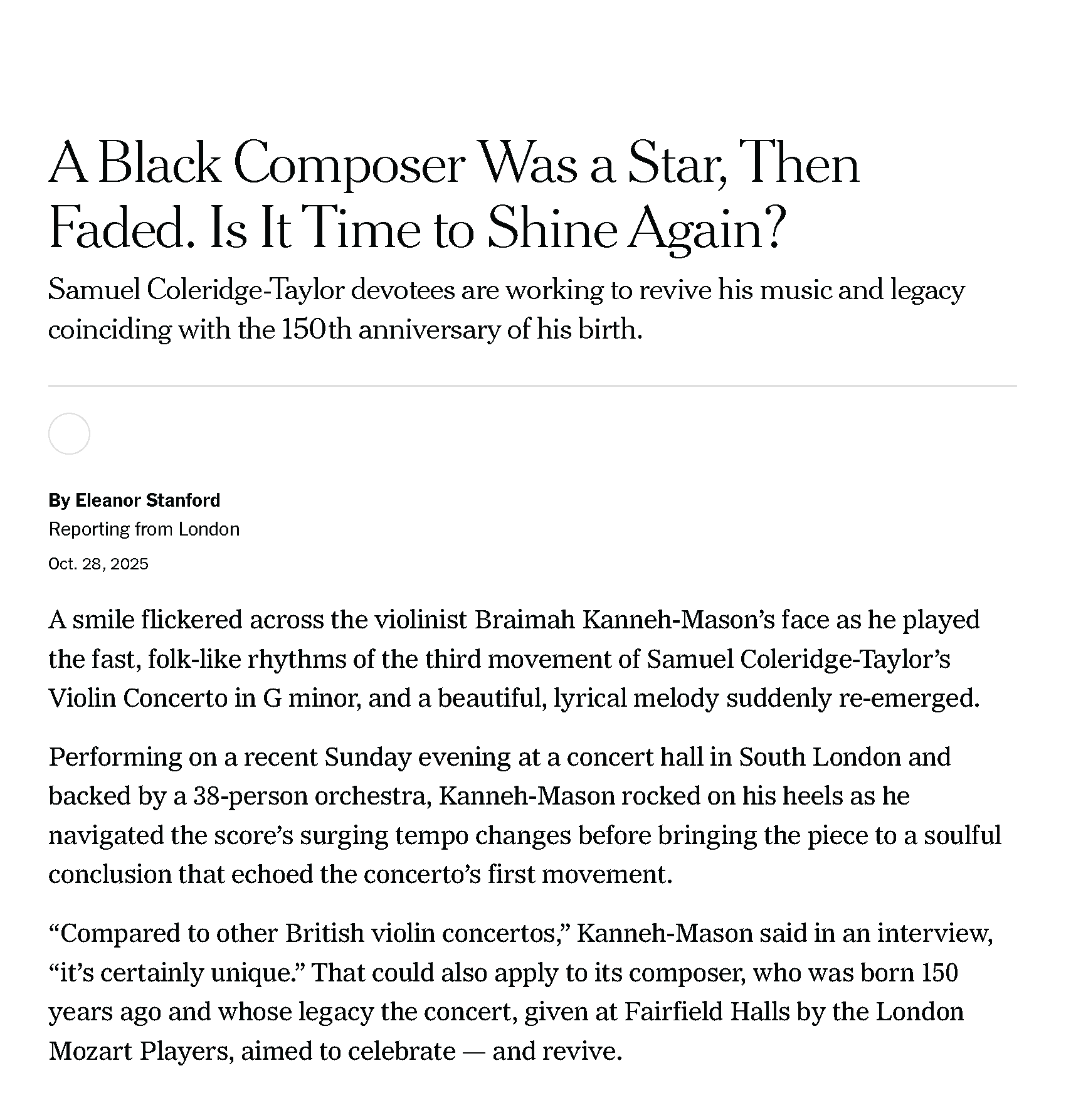
We recently sat down with director Brian Mertes to hear his thoughts about the collaboration with the MusicWorks Collective on Lab Concert #1:

“This idea of a Lab Concert is a space for Resident Musicians to try approaching things in different ways. Normally in the process of selecting and creating a program it’s very traditional, there’s a set way of going about it. Pick the music, go learn the music, learn your part, come together, play it. 

So we played around with changing just that. How are you going to pick the music? Whose voices are part of picking the music but also, why are we picking music? What is it that we’re after? What is it that we’re trying to engage in?

 For me, surprise is a very high value. I’m seeking surprise when I’m building a performance and I’m seeking ways to interrogate the conditions, to create impediments, to try to establish a kind of presence that is intimate, vulnerable, connected, and unknown. 

So how do you go to an unknown place when you know the music inside out? How do you allow yourself inside of that space of performance to both be present and also bring to the music and the people you’re sharing with, the musicians you’re playing with, all of your expertise and virtuosity? I feel like we’re playing with those questions in a really wonderful way, and it’s exciting. 
We’re providing a little bit of light on January 16th. It’s warmth and light. We’re gathering to hear what these four wonderful musicians are thinking about. It’s really from the heart.”

Brian Mertes is Head of the Brown University/Trinity Rep MFA Directing Program, and an Associate Director at Trinity Rep. He has taught directing for Columbia and NYU film programs and has been a guest director at North Carolina School of the Arts, SUNY Purchase, NYU Grad, UT Austin, and Yale. Brian has directed many world premieres and was a guest director at Juilliard for over two decades. Brian has directed for ABC, CBS, NBC and Fox, garnering three Emmy and three Directors Guild of America nominations, and an Emmy for directing. Brian is a member of the CMW board, is a CMW parent, and resides in the West End of Providence. 

Join us for this event!
Learn more on our calendar

MusicWorks Collective with Brian Mertes
Lab Concert #1: Music Meets Theater
Friday, January 16 at 7:30 pm
The CMW Center
1326 Westminster Street, Providence

Reserve your seat: https://bit.ly/4jFxeSL


It’s Been A Year!

One year ago, Community MusicWorks opened the doors to The CMW Center.

This vibrant new home was made possible through the dedication, creativity, and collaboration of a remarkable community — including CMW students and their families, our West End neighbors, 3SIX0 Architecture, Pezzuco Construction, Healthy Materials Lab, Arup Acoustic Consulting, our generous funders and supporters, and many, many others.

With the halls of The CMW Center now animated with music, joy, and possibility, we’re deeply grateful to everyone who joined us in over a decade of planning and hard work to bring this vision to life.

Take a moment to look back at the highlights of the journey that built The CMW Center — and we hope to see you at our next event!

Check out our events calendar

Video by Atomic Clock

Joy, Purpose, and Camaraderie through Music

“The melodies drifting from Community MusicWorks’ spacious building are more than just the sounds of young musicians practicing. They are the heartbeat of the neighborhood.”
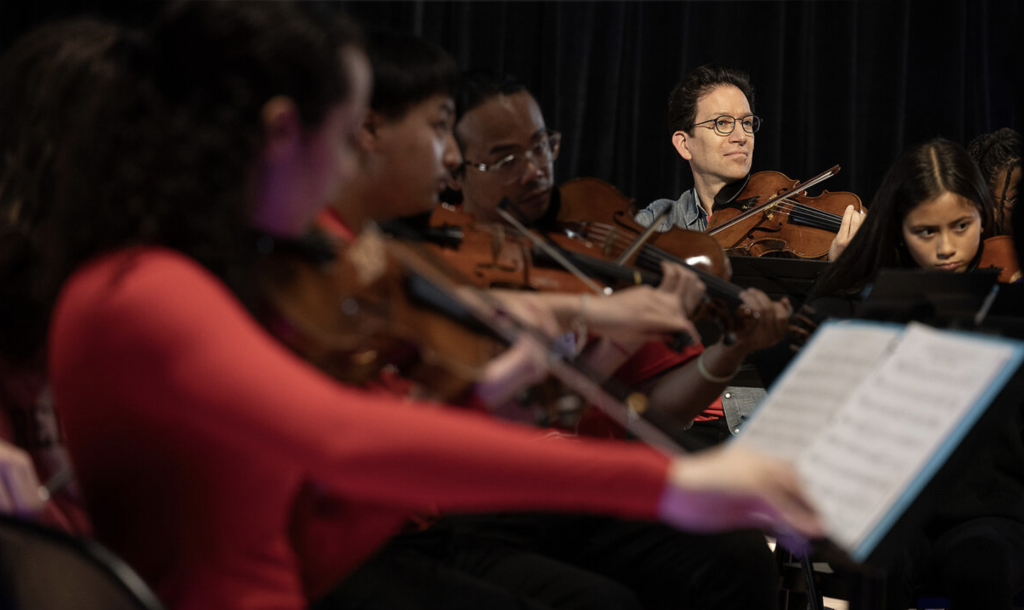
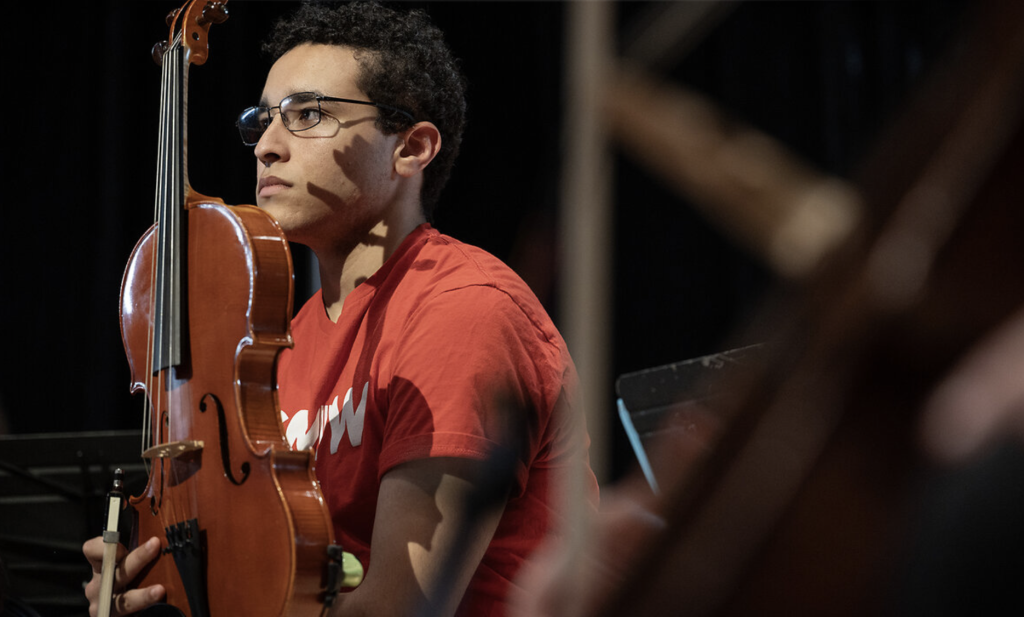
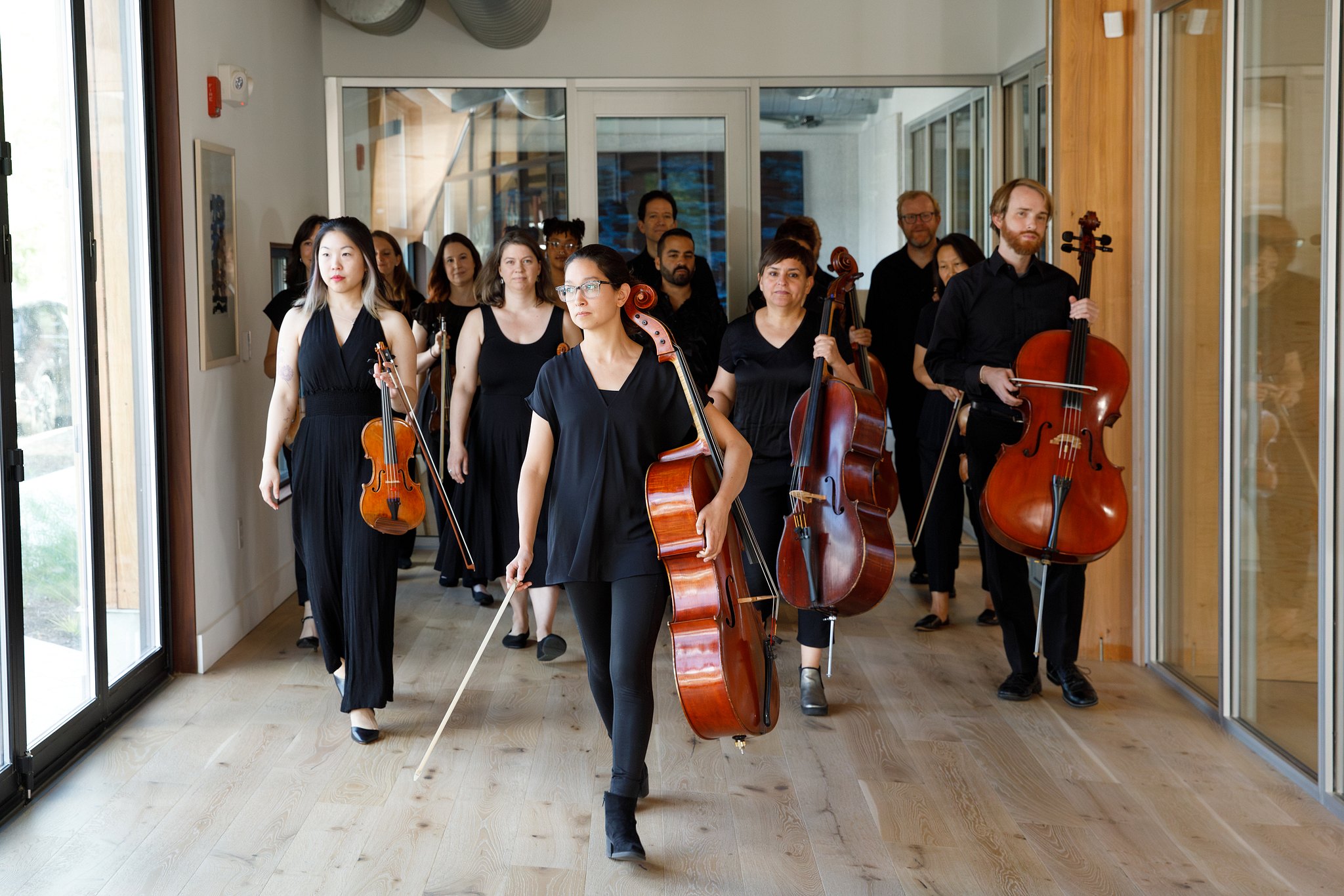
CMW recently welcomed Christian Science Monitor reporter Troy Sambajon into the halls and lesson rooms of the CMW Center to learn more about the people and programs of Community MusicWorks.

“In an era when many schools’ arts budgets are dwindling, CMW offers something increasingly rare: a space where young people find joy, purpose, and camaraderie through music,” he writes. “CMW nurtures a feeling of connection as well as curiosity and leadership.”

“The arts aren’t just about skill-building or learning to play an instrument,” CMW Founder & Artistic Director Sebastian Ruth told Mr. Sambajon. “It’s a different way of being with other people.”

“We talk just so we don’t feel alone in the questions we have.” Student Cesar reflected on CMW as a place of connection.

Read it here

Photos by CSM staff photographer Alfredo Sosa

Welcome to Season 29!

As we launch the second full season in our new home at
the CMW Center, we’re thrilled to embark on a journey
through diverse and vibrant musical landscapes—together
with you!

Season 29 begins with a festive late-summer open house
and concert, featuring the rich lyricism of Dvořak’s Piano
Quintet, the dynamic Concerto for String Orchestra by
Portuguese composer Joly Braga Santos, and quartets
by Hawa Diabaté and Merlijn Twaalfhoven from the Kronos
Quartet’s Fifty for the Future commissioning project.

In mid-fall, we turn our gaze to the cosmos with music
inspired by the spheres, including works by Beethoven,
Ligeti, Aaron Jay Kernis, and Laura Cetilia. December
brings the return of Songs of Darkness and Light, a
program of stories and music reflecting themes of the
winter solstice.

We welcome the Apple Hill Quartet in January, joined by
longtime CMW collaborator Kareem Roustom. In February,
MusicWorks Collective presents a powerful program
centered around George Crumb’s haunting Black Angels,
including a residency with composer Aleksandra Vrebalov,
whose piece ilektrikés rímes—written for electric instruments
and glass harmonica—echoes Crumb’s groundbreaking
soundscape.

Season 29 concludes with a collaboration between the
MusicWorks Collective and CMW students performing
works by Gabriella Smith, Inti Figgis-Vizueta, and Ralph
Vaughan Williams’ beloved Fantasia on a Theme by
Thomas Tallis.

In addition to these offerings, this season also includes
the return of the intimate Sonata Series, the overnight Bach
to the Future marathon, performances by CMW student
ensembles, special guests, and appearances around town.

Join us for a season filled with bold musical adventures and
community celebration!

— Sebastian Ruth, Founder & Artistic Director

Check out our events calendar

Photo by Atomic Clock

Phase II at Home

In this video by local filmmakers Atomic Clock, you’ll hear our extraordinary Phase II students share thoughts about their time at CMW, and what “home” means to them. You’ll also learn what it means to be a participant in CMW’s Phase II, and what lies at the heart of not only our Phase II teen leadership program, but in all the work we do at CMW: relationships and community.

Senior Phase II violist Cesar says, “I feel like that’s what I will take away the most, that I’m here for someone whenever they need it, and whenever I need it I know someone’s there for me, too.”

About Phase II

Phase II is CMW’s youth leadership program where teens participate in a weekly meeting that fosters critical thinking and leadership skills, strengthens musicianship, and builds a close-knit peer group through rehearsals, performance, and discussions centered around important issues in their lives and their community.

Phase II students gather on Friday evenings with staff for topic discussion, chamber music, and a shared meal. Participation is by audition. When accepted into Phase II, students take on an extra level of responsibility –mentoring younger students; representing CMW at conferences, meetings, and in other settings; and several Phase II students lend their voices as CMW board members.

Each spring, Phase II students organize a Youth Salon, an evening of performance, conversation, and a shared meal, focused on an issue that they identify. Past topics chosen, explored, and presented by students included creative voice, exploring ways to be heard, and music as a cultural lens.

This year, the Phase II students chose “Home” as a theme for the Youth Salon, inspired by CMW’s new home in the CMW Center. Students then extended that theme in their choice of the song “Home” performed by the entire student body and staff in the End-of-Year Student Gala.

“Home” is an arrangement by Walter Muelling of Edward Sharpe and the Magnetic Zeros recording, written by Alexander Ebert & Jade Allyson Castrinos.

Watch more CMW videos on our YouTube page.

Program Notes: MusicWorks Collective Season Opening Concert

Enjoy this deep-dive into the compositions on Sunday’s program, then make your reservation to join us at the CMW Center!

José Manuel Joly Braga Santos: Concerto for Strings in D
Notes by Jesse Holstein

A highly accessible work, the first movement opens forcefully with a stately, muscular  theme in the violins atop insistent pounding below in the lower strings. A spaciousness opens up and we hear Kimberly, Miguel, and Sebastian singing out a melancholy tune that seems to pay homage to Ralph Vaughn Williams or Big Ralph (as he was not called by anyone). The tempo quickens with a recycled snippet from the opening theme and we are off on a frenetic and determined scamper. Akin to a Baroque Concerto Grosso,  the solo violin and  cello emerge from the texture prior to the movement’s impassioned and lyrical second theme. After a brief development and recapitulation, the movement closes quietly with three pizzicatos by guest artist Justin McCarty on the double bass.

The second movement opens with a repetitive march-like dirge that sets up a somber and heartfelt violin theme. This movement was actually played at the composer’s own funeral in 1988. The procession pauses briefly in the middle of the movement for an emotional release before returning to the elegaic march from the beginning. This time, we hear the melody sung by a solitary viola and some elegant variations in the second violins. 

The English influence is again unmistakable in the final movement. A country dance skips across the landscape in a sunny D-major. Something is a bit peculiar however as Santos chooses a meter of 5 beats per bar instead of the customary 2 or 4,  giving the musical flow a unique lilt. Written in a rondo (or refrain) form, Santos has some fun deconstructing the melody harmonically and rhythmically in the episodes between the statements of the main theme. An acceleration  and drive to the end closes a very satisfying work by an unjustly unknown voice.

Hawa Kassé Mady Diabaté: Tegere Tulon
Notes by Professor Lucy Durán

Tegere Tulon revisits the handclapping songs of Hawa Diabaté’s childhood, which were such formative experiences for her, and which are gradually dying out except in remote villages. Performed exclusively by girls outdoors in a circle, usually on moonlit nights, the handclapping songs are normally very short, consisting of one or two phrases repeated in call and response, often involving counting, each one with its own dance. Children make them up spontaneously, using the rhythms of language to generate musical rhythm, with playful movements, some individual, some coordinated by the whole circle.

Building on her own memories of the handclapping songs she used to do as a young girl in Kela, Hawa has created four new pieces in handclapping style, which she hopes will encourage Malians not to abandon this rich cultural heritage. The lyrics are humorous and poignant—they talk about the importance of family, the teasing relationship between kalime “cross-cousins” (a man’s children and his sister’s children are cross-cousins), a girl who loves dancing so much she falls into a well and then climbs out, and how long it takes to get to Funtukuru, her husband’s village, where she went to film handclapping.

Read the full program notes here

Merlijn Twaalfhoven: Play
Artist statement by the composer

“What is music making? Is it high performance? Or can it be … play? Is it the delivery of an achievement with set expectations or can it be open to the moment, challenge the players and connect everybody?

In the classical music of today, the separation of performer and listener is very strict and clear. We might forget how for centuries (and still today, outside the conventional concert halls), music was the most effective way to connect, to create together, to participate, to play. Both in religious service as in celebrations or ritual, music establishes a sense of unity.

Today, our society is fragmented and divided. Can musicians play a role to create new forms of connectedness and community? In this composition, I invite all people that are present to contribute and … to play.”

Play and Tegere Tulon were composed for 50 For The Future: The Kronos Learning Repertoire. Learn more about the project here

Antonín Dvořák: Piano Quintet
Notes by Jesse Holstein

Atop the gentle lilt of the piano, a most lyrical and touching opening theme in the cello begins our journey. Suddenly, a dramatic emotional and harmonic pivot injects a serious and rhythmic energy to the narrative. Written in the customary sonata-form,  the wistful second theme is introduced by the viola before being picked up by others. Dvořák’s ability to present both themes through multiple emotional hues is on full display in this large-scale movement. After a development section playing with both principal themes, a recapitulation and a monumental coda bring this deeply rewarding first chapter to a close. 

Part of the confidence that Dvořák found with his acceptance by Brahms and Simrock, and subsequently the musical establishment, was the courage to be himself and to celebrate his Bohemian heritage. The middle two movements of the quintet pay homage to his background with two of his favorite Czech dances as the vehicles: a stately and elegant Dumka followed by a scampering Furiant. The second movement Dumka  follows a customary roadmap of quicker, more upbeat interludes between the somber main theme. It is none other than the viola (one of his primary instruments) that presents the Dumka theme at the outset. 

While the third movement is marked Scherzo, Dvořák parenthetically added Furiant to the title. While it lacks some of the usual rhythmic idiosyncrasies of a traditional Furiant, the intent is to possibly inject some Furiant-like energy into the mix after the elegiac Dumka. The trio captures a wonderfully spacious nostalgia that ironically employs some of the rhythmic characteristics of a typical quick Furiant before the return to the quicker opening material.

The finale opens with a bristling expectancy before a most satisfied and joyous melody in the first violin lets us know that this is going to be a fun conclusion to the work. Indeed, in this proverbial “victory-lap” finale, Dvořak fully squeezes every expressive and compositional drop out of the main theme and the warm, dancing second theme.  Packaged in a rondo structure, he has tremendous fun with both themes using imitation, call and response, games of tag, a raucous Bohmian Fugue, and towards the end, slowing the main theme down very slowly into a stately chorale before the final push to the finish line. 

Intrigued? Make your reservation for Sunday’s concert!


Students

Teachers

Classes

Performances, Events, Projects